Weekly Roundup: Anthropic's IPO Sparks a Busy Week for Onchain Finance
Market & Insights
November 21, 2026
Anthropic’s IPO brought tokenized stocks to the spotlight as onchain finance expanded and global markets faced a sharp correction. Here’s what changed across RWA, DeFi and Solana.

This week, November 15 to 21, brought major developments across digital assets and traditional finance. Anthropic went public, and tokenized versions of its stock began trading onchain within minutes of its Nasdaq debut. Solana Breakpoint brought new announcements around tokenized equities, lending and payments, while several DeFi protocols expanded their support for real-world assets.
At the same time, financial markets faced significant pressure. The S&P 500 entered correction territory, Nvidia recorded a sharp weekly decline despite reporting record financial results, and Bitcoin fell towards $60,000. Expectations around the Federal Reserve’s December interest rate decision also remained uncertain.
Tokenized Stocks: Anthropic’s IPO and the Expansion of Onchain Equities
Anthropic stock arrives onchain on its first trading day
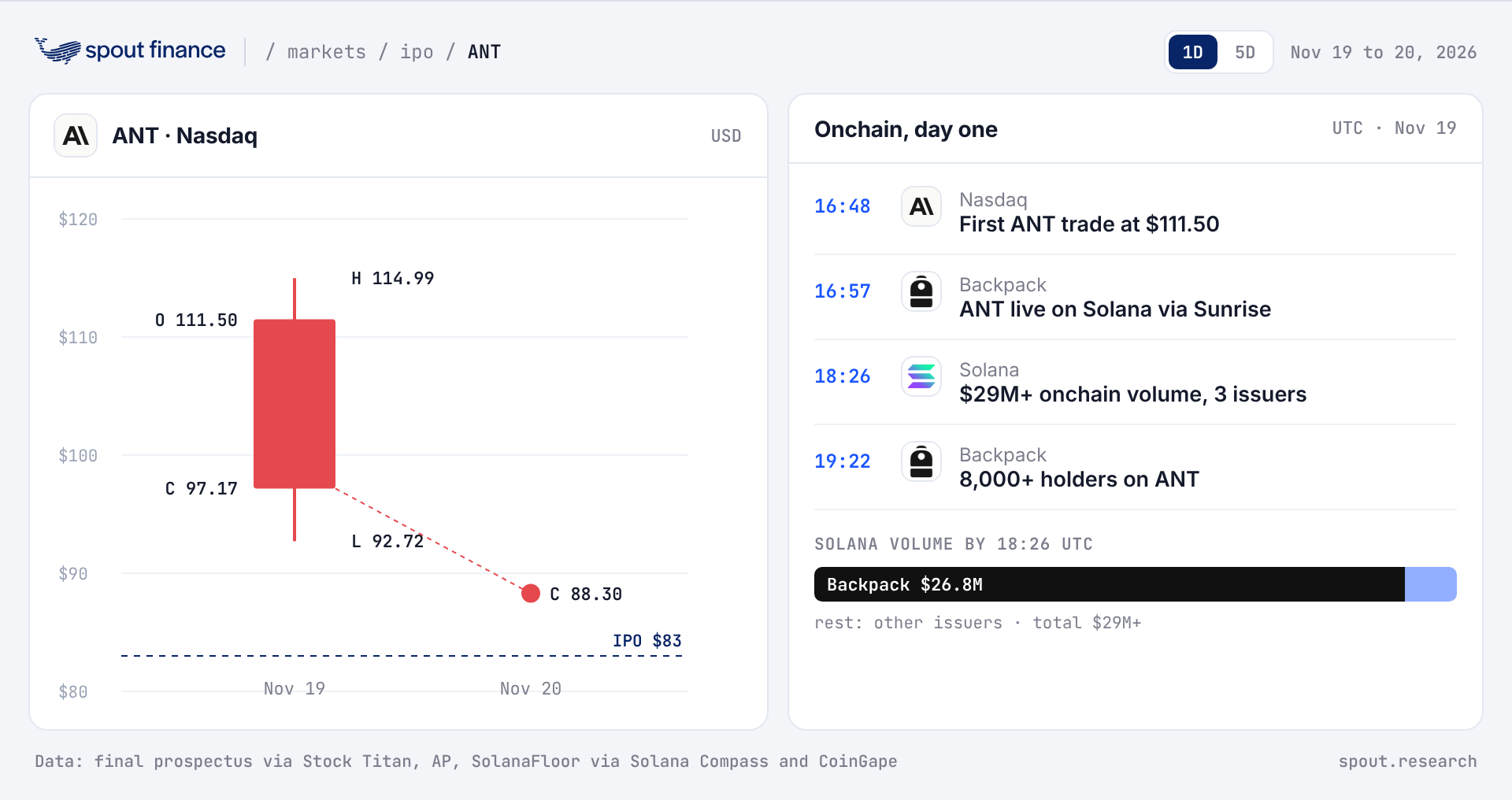
November 19 marked Anthropic’s public market debut on Nasdaq, and several platforms moved quickly to introduce tokenized versions of the shares.
Backpack listed its ANT token on Solana through Sunrise at 16:57 UTC, nine minutes after the first Nasdaq trade. By 18:26 UTC, combined Solana trading volume across three issuers had exceeded $29 million. Approximately $26.8 million came from Backpack’s token.
Backpack’s ANT token also passed 8,000 holders by 19:22 UTC, according to SolanaFloor data cited by Solana Compass and CoinGape.
Other platforms introduced their own versions:
- Ondo offered ANTon to eligible investors outside the United States.
- Binance distributed xStocks’ ANTx token.
- Securitize introduced tokenized Anthropic shares on Solana.
- Dinari launched its own tokenized Anthropic shares, according to Forbes.
These products do not provide identical rights. Binance’s ANTx, for example, does not carry ownership, voting or dividend rights. None of the tokenized products is sponsored by Anthropic.
Securitize tokenizes Anthropic shares with security entitlements
Securitize also brought Anthropic shares onchain on November 19, using Solana as the settlement network.
Its tokens represent security entitlements backed one-for-one by Anthropic shares held through Securitize Markets. Transactions settle in USDC, and voting entitlements pass through under the product terms.
The offering is available to eligible investors in the United States, the European Union and other permitted jurisdictions. Jump Trading supports liquidity.
Securitize also added Amgen and Fox to its tokenized stock offerings, taking its supported US stocks beyond 50.
The structure is worth noting because tokenized stocks do not all represent the same level of shareholder rights. Some provide price exposure, while others are structured around security entitlements and specific rights under their product terms.
Bullish agrees to acquire Equiniti for $4.2 billion
At Solana Breakpoint on November 16, Bullish announced its planned $4.2 billion acquisition of UK transfer agent Equiniti.
The transaction includes a notable tokenization component. Bullish said sellers would receive payment in tokenized Bullish shares issued on Solana.
Bullish has also been developing its own tokenization infrastructure, making the announcement another example of a company using blockchain-based shares as part of a major corporate transaction.
xStocks expands its integration with Jito’s JTX
On November 16, xStocks announced that more than 1,000 tokenized stocks and ETFs would be available through Jito’s JTX, with quote requests of up to $1 million.
Sunrise also announced an API for trading and company data connected to Backpack’s tokenized stocks on Solana.
These integrations add more access points for tokenized equities and support the development of infrastructure around their trading and distribution.
Ondo’s SPYSHIELDon passes $75 million
Ondo reported on November 17 that its Intelligent Portfolios held eight products with more than $75 million in assets across Solana and other blockchain networks.
The announcement highlighted continued interest in tokenized investment products and the expansion of Ondo’s offerings beyond individual tokenized stocks.
Tokenized stocks on Solana reach $1.22 billion
Tokenized equities on Solana reached approximately $1.22 billion on November 19, nearly double their value at the end of October.
The figure was reported in a Solana post citing Blockworks.
Another development came from the growth in token issuance. Over the 11 weeks leading up to November 13, minting added $1.12 billion to tokenized stock value, while price movements reduced the total by $339 million.
Binance’s bStocks accounted for approximately four-fifths of the new minting, with NVIDIA, SpaceX and Circle among the leading assets.
The Block also reported that tokenized stocks crossed $4 billion on November 11, with approximately 10% of tokenized stock value open to US investors.
OKXICE prepares for its November 23 launch
OKXICE is scheduled to open on November 23 with more than 70 assets.
The planned offering includes shares connected to Coinbase, Circle, Robinhood, Strategy, BitGo, Securitize and Better.com, alongside 59 Direxion ETFs.
Securitize will tokenize the assets, which are expected to trade through Uniswap v4 pools on X Layer for eligible US customers.
However, the initiative has faced resistance from listed companies. Sixty-seven companies objected to having their shares included, including every company in the Magnificent Seven.
The launch will be an important development to watch as tokenized securities platforms continue to navigate issuer consent and regulatory requirements.
Tokenized stock market data
RWA.xyz data read on November 20 put the distributed value of tokenized stocks at $3.56 billion.
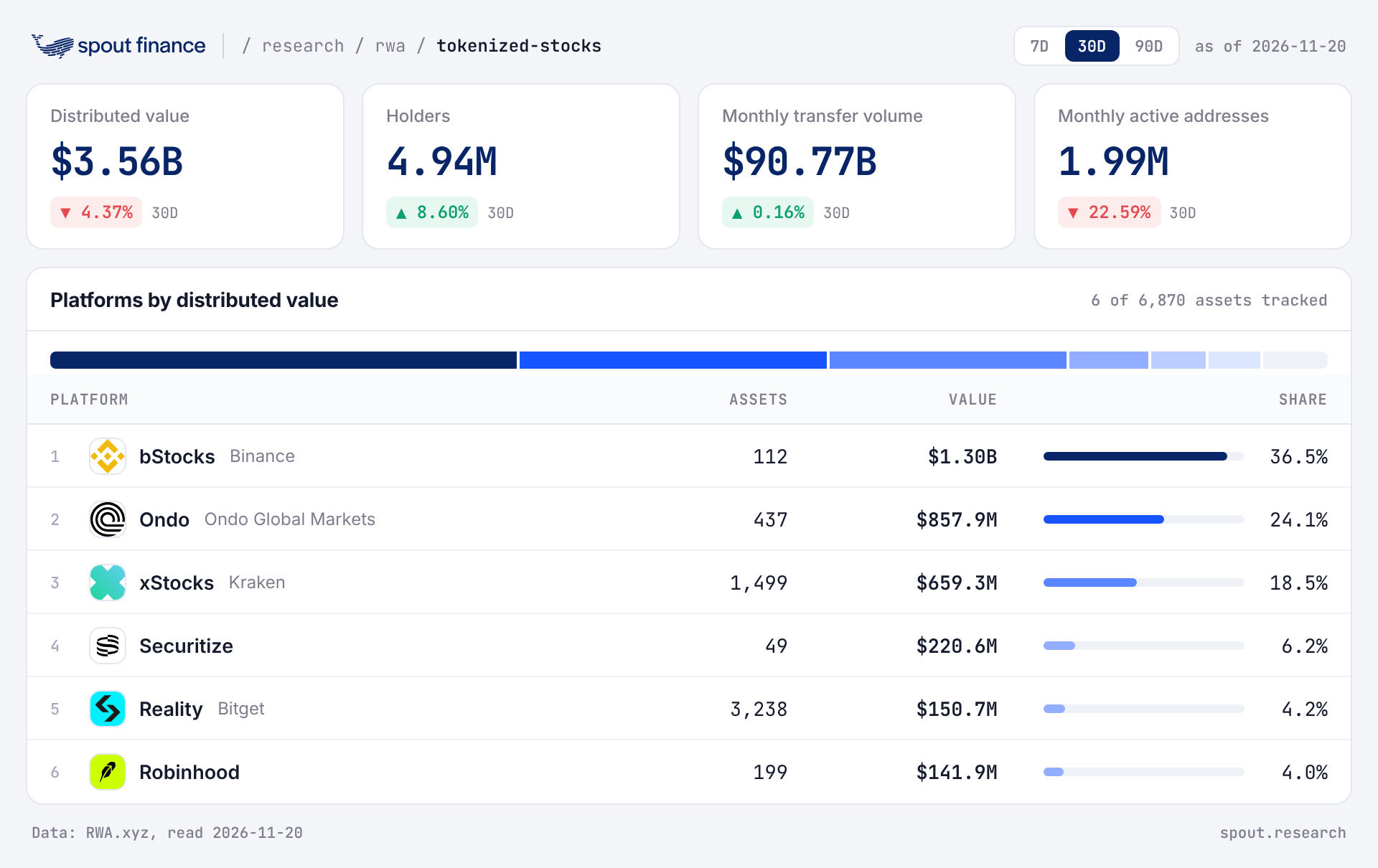
The figures show that tokenized stock ownership continued expanding even as the market’s distributed value declined over the previous 30 days.
DeFi and Stock-Backed Lending
Jupiter announces lending market for Bullish’s tokenized shares
Jupiter announced a permissioned Jupiter Lend market at Solana Breakpoint on November 16.
The planned market will allow verified users to borrow against Bullish’s tokenized BLSH shares on Solana.
Access will require identity verification through Jupiter’s Global Passport. Bullish tokenized its own shares directly, rather than relying on a third-party issuer.
The market has been announced but has not opened. As of the reporting period, no official launch date, loan-to-value ratio or liquidation terms had been published.
The development introduces another approach to stock-backed borrowing, with lending access connected to issuer-direct tokenized shares.
Kamino relaunches its application around real-world assets
Kamino relaunched its application on November 16 with an Assets Hub featuring more than 100 real-world assets.
The redesigned application includes updated Earn, Borrow and Multiply products.
The changes place tokenized assets more prominently within Kamino’s lending and liquidity experience, reflecting the growing role of real-world assets in DeFi applications.
Morpho goes live on OKX’s X Layer
On November 18, Morpho launched on OKX’s X Layer with a Gauntlet-curated USDC vault and borrowing markets that accept xStocks as collateral.
The launch also included a $350,000 incentive campaign through OKX Wallet.
Of this amount, $200,000 was allocated to users posting xStocks as collateral.
The integration brings Morpho’s lending infrastructure into another ecosystem and adds incentives for users looking to use tokenized equities within DeFi.
Lending protocol TVL
DefiLlama data read on November 21 showed mixed performance across major lending protocols over the previous seven days.
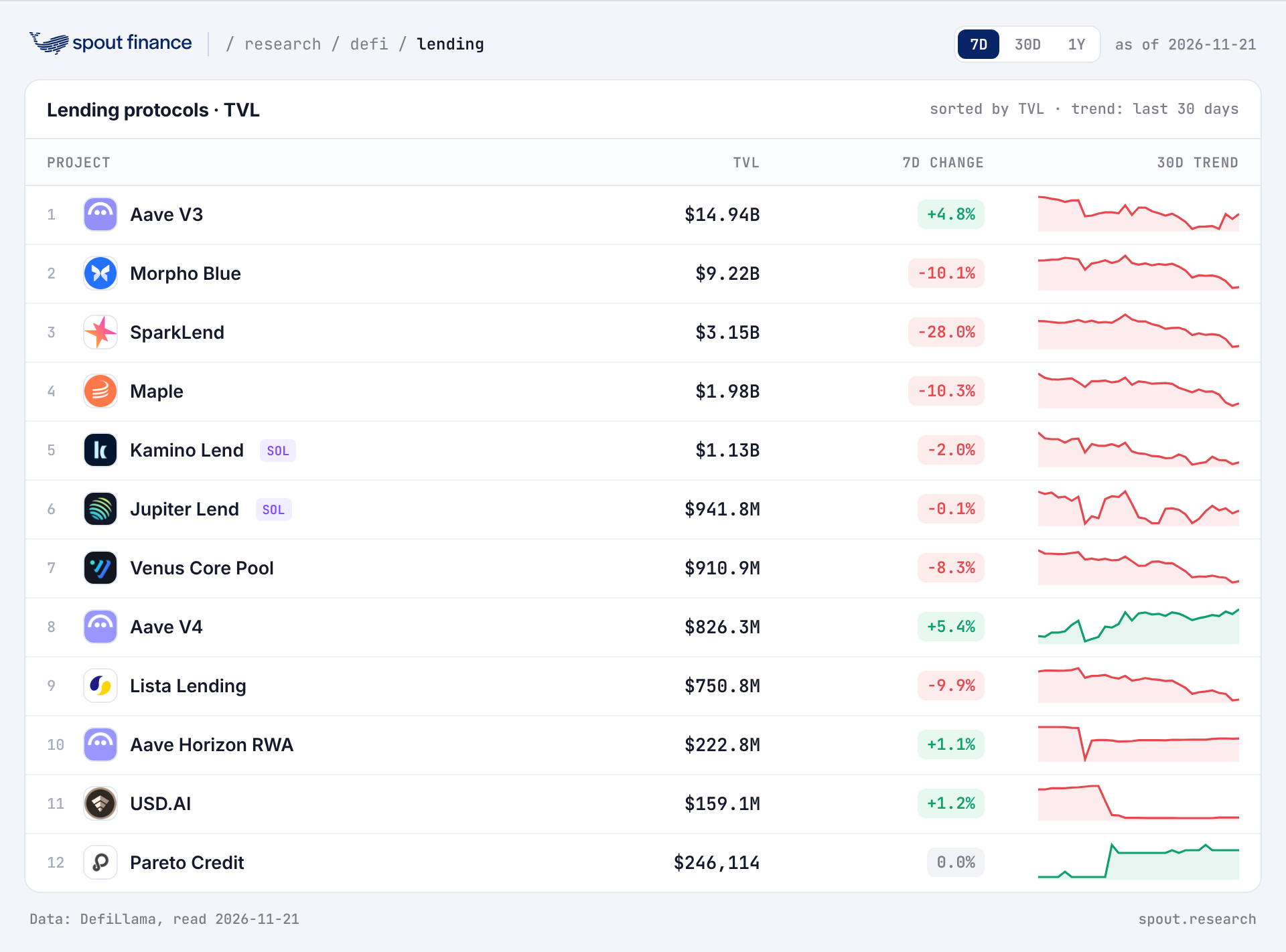
Aave V3, Aave V4, Aave Horizon RWA and USD.AI recorded weekly increases, while several other large lending protocols experienced declines.
Solana: Breakpoint, Payments and Network Developments
Solana Breakpoint takes place in London
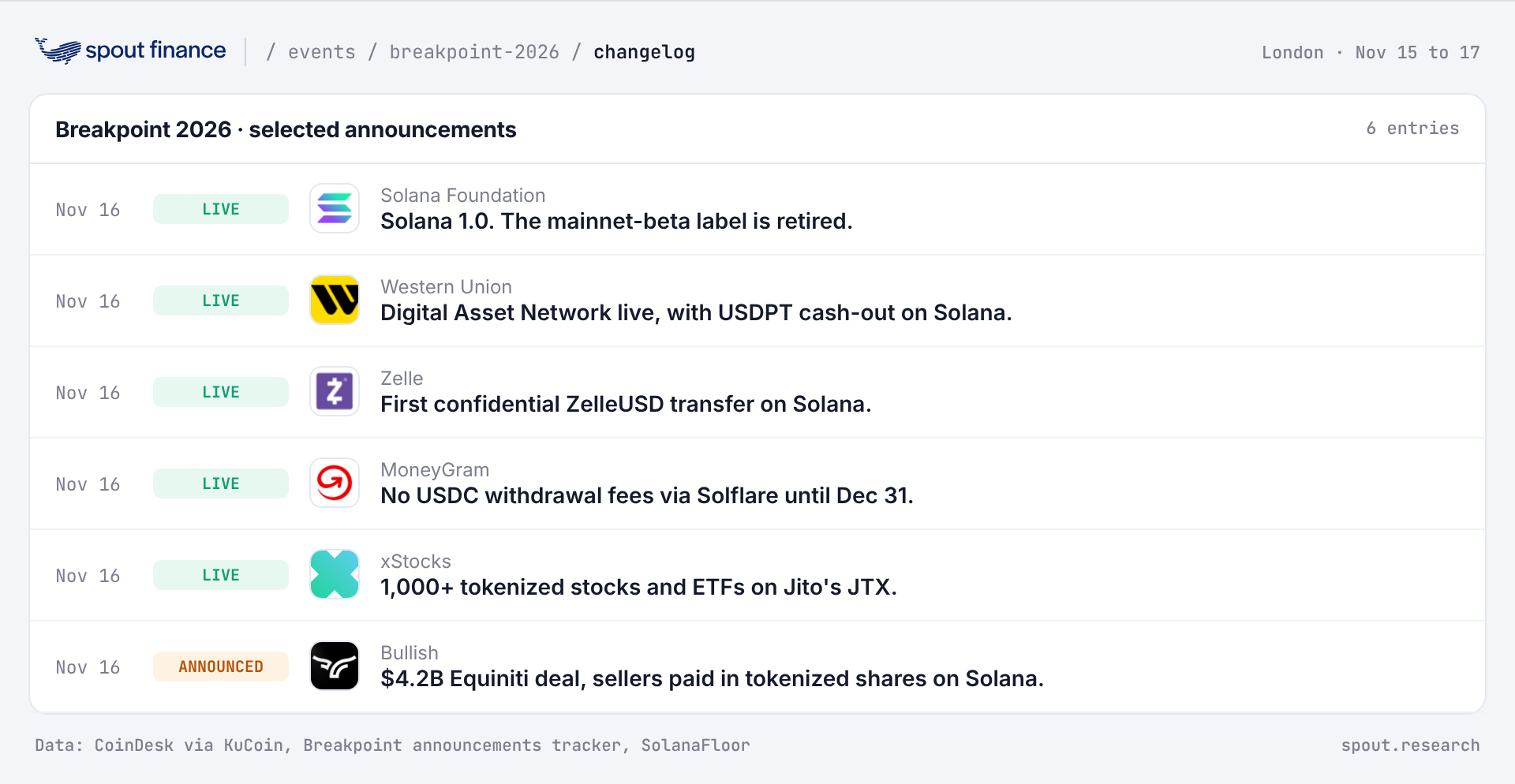
Solana Breakpoint ran from November 15 to 17 at Olympia in London, attracting more than 7,000 attendees.
The event brought together developers, institutions, infrastructure providers and ecosystem participants. Announcements covered tokenized assets, lending, payments and the wider development of Solana’s financial infrastructure.
Solana also confirmed that Breakpoint 2027 will take place in San Francisco from September 8 to 10.
 Solana 1.0 retires the mainnet-beta label
On November 16, the Solana Foundation announced Solana 1.0, retiring the mainnet-beta label.
The change reflects the network’s progression, with the Agave and Firedancer clients mapping to one shared protocol version.
It marks a change in how Solana presents its network status as development continues across its validator clients.
Western Union, Zelle and MoneyGram announce payment developments
Payments were another major theme at Breakpoint.
Western Union announced that its Digital Asset Network was live, including cash-out functionality for its USDPT stablecoin on Solana.
Zelle completed its first confidential ZelleUSD transfer on Solana, while MoneyGram announced that it would waive USDC withdrawal fees through Solflare until December 31.
These developments highlight the different ways payment providers are exploring blockchain infrastructure, from stablecoin transfers to cash-out services and lower-cost withdrawals.
SOL declines over the week
Solana’s native token experienced another difficult week.
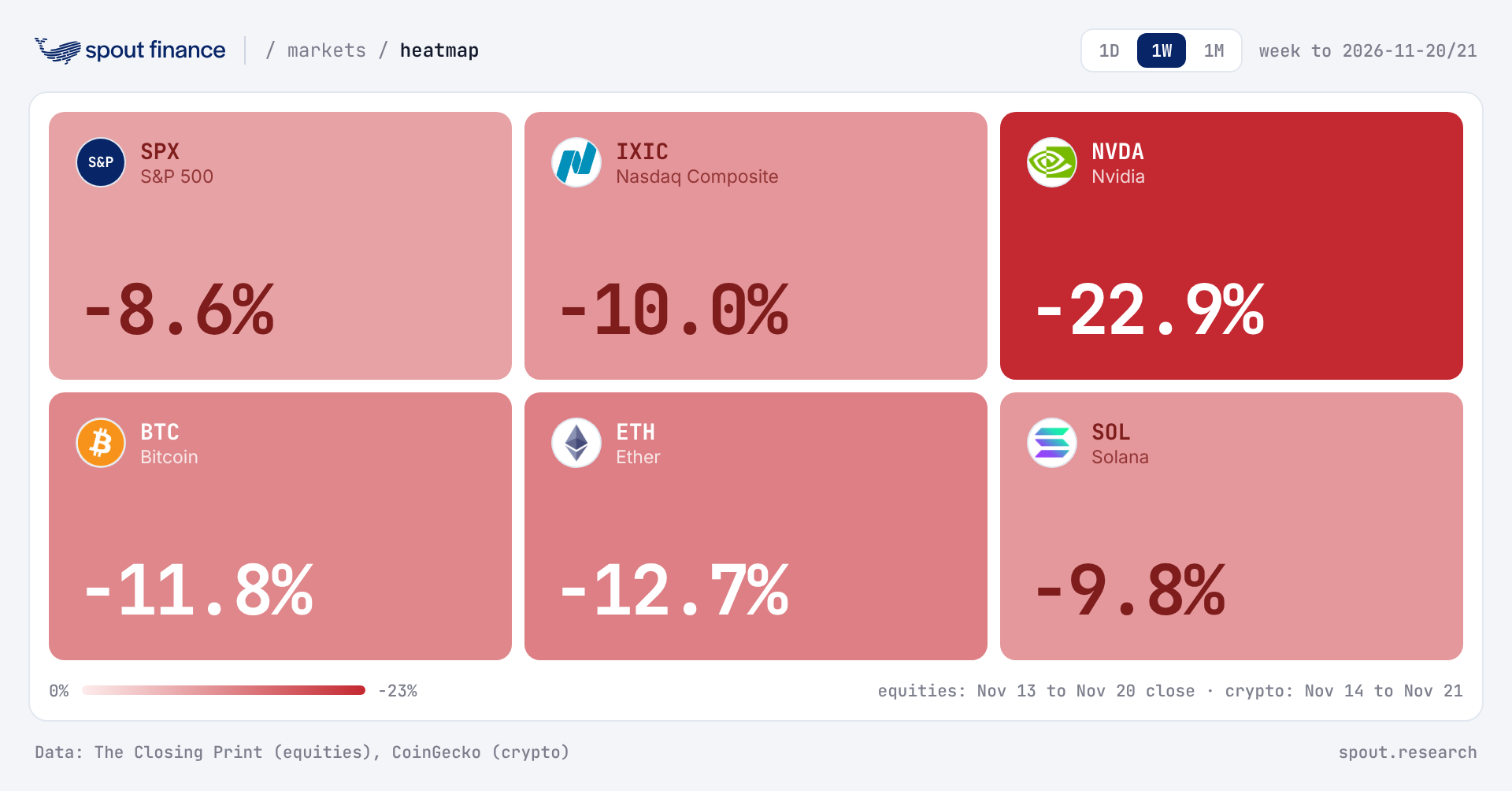
CoinGecko data showed SOL trading at approximately $78 on November 14 before declining to around $71 by November 21, representing a weekly decrease of roughly 10%.
The decline came amid wider weakness across crypto markets.
TradFi: Anthropic, Nvidia and the Market Correction
Anthropic completes its IPO
Anthropic priced its IPO at $83 per share on November 18, above the expected range of $70 to $78.
The offering involved 980 million shares, raising approximately $81.34 billion. A separate $26 billion sale of non-voting shares went to seven technology companies.
On November 19, the stock opened at $111.50 and closed at $97.17, a gain of 17.1% against its IPO price.
By November 20, it had declined another 9.1% to $88.30.
The public listing also became a major moment for tokenized equities, as several platforms introduced onchain versions of the stock on its first trading day.
Nvidia reports record financial results
Nvidia reported revenue of $115.8 billion for its third quarter of fiscal 2027, representing a 103% increase from the previous year.
Data centre revenue reached $107.6 billion, while the company issued fourth-quarter revenue guidance of $130 billion, plus or minus 3%.
Despite the strong financial results, the company’s leadership situation remained a major talking point.
Board chair Harvey Jones said the board did not intend to reinstate Jensen Huang as CEO.
Nvidia shares also experienced significant pressure during the week, falling approximately 22.9%, according to The Closing Print.
S&P 500 enters correction territory
November 20 brought a major shift in US equity markets.
The S&P 500 fell 3.7% to 6,910.39, marking its seventh consecutive daily decline and placing it more than 10% below its October 6 high.
The Nasdaq dropped 5.3% and turned negative for 2026. Nvidia also fell approximately 14% during the session.
For the full week, The Closing Print reported:
 The correction reflected growing pressure across equity markets, even as some major companies continued reporting strong financial results.
Lagarde warns about fragmentation in Europe’s tokenized markets
European Central Bank President Christine Lagarde raised concerns about the future structure of Europe’s tokenized financial markets.
Speaking at the European Banking Congress in Frankfurt on November 20, she warned that Europe risked developing separate tokenization platforms that would not be able to settle with one another.
She stressed the importance of shared rules and coordination between platforms, saying: “Common rules will be needed too, and those lie with legislators.”
Her comments highlight an important issue for tokenized financial markets: interoperability and consistent regulatory standards will matter as more institutions introduce blockchain-based financial products.
Regulation and Policy
US senators question the SEC’s tokenized stock exemption
On November 16, four Democratic senators wrote to SEC Chair Paul Atkins questioning the Innovation Exemption for tokenized securities, which the SEC issued in September.
Senators Alsobrooks, Gallego, Warner and Cortez Masto raised concerns about how the exemption would address know-your-customer and anti-money-laundering requirements.
They also questioned who would be permitted to receive tokenized securities and raised issues around retail investor protections, pricing and issuer opt-outs.
The senators argued that changes to the regulatory framework should go through a formal rulemaking process.
Their concerns reflect the wider debate around how tokenized securities should fit within existing financial regulations.
SEC nominee supports a formal rulemaking process
The regulatory discussion continued on November 19 during the Senate Banking Committee hearing for SEC nominee Kristin Johnson.
Johnson expressed support for a formal notice-and-comment rulemaking process for the tokenization exemption.
Republican nominee Steven Levine described the exemption as narrow and time-limited.
The discussion adds to the uncertainty surrounding the future regulatory treatment of tokenized securities, particularly around investor protections, compliance and the transfer of digital securities.
Key regulatory questions remain
Several questions remain unresolved:
- How will KYC and AML requirements apply to tokenized securities and their transfers?
- Who will be eligible to receive and hold these tokens?
- What protections will apply to retail investors?
- Should the Innovation Exemption remain in place, or should the SEC introduce a formal rule?
The answers will influence how tokenized securities platforms operate and how widely these products become available.
Macro and Market Conditions
Federal Reserve minutes keep a larger December hike in focus
Minutes from the Federal Reserve’s October meeting were released on November 18.
The Fed had held its benchmark interest rate within the 3.75% to 4.00% range in a 10 to 2 vote.
The minutes showed that a couple of participants were open to a rate increase larger than 25 basis points in December if inflation failed to improve.
This kept the possibility of a more aggressive monetary policy response in focus.
Fed officials maintain a hawkish tone
Federal Reserve officials continued expressing concerns about inflation and monetary policy.
On November 18, Governor Christopher Waller said the Fed might need to “shock people” with a half-point rate increase.
Governor Lisa Cook said on November 20 that monetary policy was not restrictive enough.
CME FedWatch data put the probability of a 50-basis-point December increase at approximately 10% on November 19.
The comments kept interest rate expectations uncertain as markets assessed the potential impact of tighter monetary conditions.
Economic data provides a mixed picture
Economic releases during the week showed:
- October retail sales increased by 0.2%.
- Initial jobless claims came in at 203,000.
- University of Michigan consumer sentiment stood at 51.5.
These figures added to the economic picture being assessed by investors and policymakers ahead of the Federal Reserve’s December meeting.
Treasury yields
The 13-week US Treasury bill yield stood at 4.23% on November 20, unchanged from November 13.
The 10-year Treasury yield declined to 4.92% on November 20 from 5.04%.
The movement in yields came as investors continued assessing economic conditions, inflation and the Federal Reserve’s next policy decision.
Crypto markets record further declines
Crypto markets also experienced another difficult week.
Bitcoin declined from approximately $68,300 on November 14 to around $60,200 on November 21, a decrease of roughly 12%.
Ether fell approximately 13% to around $1,690.
CoinGlass recorded approximately $2.53 billion in liquidations over the 24 hours leading up to November 21, with long positions accounting for most of the liquidations.
US spot Bitcoin ETFs also recorded $582.3 million in net outflows on November 19, according to Farside Investors.
The figures point to continued pressure across digital asset markets as investors responded to wider financial market weakness and uncertainty around monetary policy.
What This Means for Spout and Its Users
This week brought several developments directly relevant to the market Spout is building for.
Anthropic’s IPO demonstrated how quickly traditional equities are finding their way onto blockchain networks. Multiple platforms introduced tokenized versions of its shares within minutes of its Nasdaq debut, while Securitize brought its own security-entitlement structure to Solana. This highlights the growing demand for infrastructure that connects publicly traded stocks with onchain markets.
The expansion continued across DeFi. Jupiter announced plans for a lending market backed by Bullish’s tokenized shares, while Morpho introduced xStocks collateral markets on OKX’s X Layer. Kamino also expanded its real-world asset offering. These developments show that tokenized equities are increasingly being considered for use beyond trading, particularly as collateral in lending markets.
For Spout, this creates a more developed ecosystem around stock-backed borrowing. More tokenized assets, lending integrations and institutional infrastructure mean more opportunities for users to access financial services through their stock holdings.
However, this week’s regulatory discussions also highlight the importance of compliance, investor eligibility and transparency. As tokenized securities gain wider adoption, platforms will need to address these requirements while providing clear information about collateral, borrowing terms and liquidation mechanisms.
For users, the key development is the growing range of ways tokenized stocks are being used across onchain finance. The market is moving towards a model where equities serve purposes beyond holding and trading, including providing collateral for borrowing.
The Bigger Picture
This week showed how quickly traditional finance and onchain markets are becoming connected.
Anthropic’s IPO became a major moment for tokenized equities, with multiple platforms bringing its shares onchain almost immediately after its Nasdaq debut. Solana Breakpoint added momentum through announcements across tokenized assets, lending and payments, while platforms such as Jupiter, Morpho and Kamino continued expanding the role of real-world assets in DeFi.
Institutional participation also remained a major theme, from Bullish’s planned acquisition of Equiniti to Securitize’s tokenization activity and the expansion of tokenized stock offerings.
At the same time, the industry faced important questions around regulation, investor protection and how tokenized securities should operate within existing financial markets. Outside crypto, a sharp correction in US equities, declining digital asset prices and uncertainty around Federal Reserve policy added pressure to an already difficult market environment.
The week’s developments point to an industry continuing to build its financial infrastructure while navigating market volatility and regulatory uncertainty. Tokenized equities and real-world assets are gaining more use cases, and the next stage will depend on how effectively these products connect with the wider financial system.