Weekly Roundup: The Race to Turn Tokenized Stocks Into Collateral
Market & Insights
October 10, 2026
Tokenized stocks are growing, but only a small share is being used as DeFi collateral. This week’s roundup covers new tokenized stock launches, lending activity, and what the growing gap between asset supply and collateral use means for onchain borrowing.

Tokenized stocks are becoming easier to access, but using them as collateral is still a small part of the market.
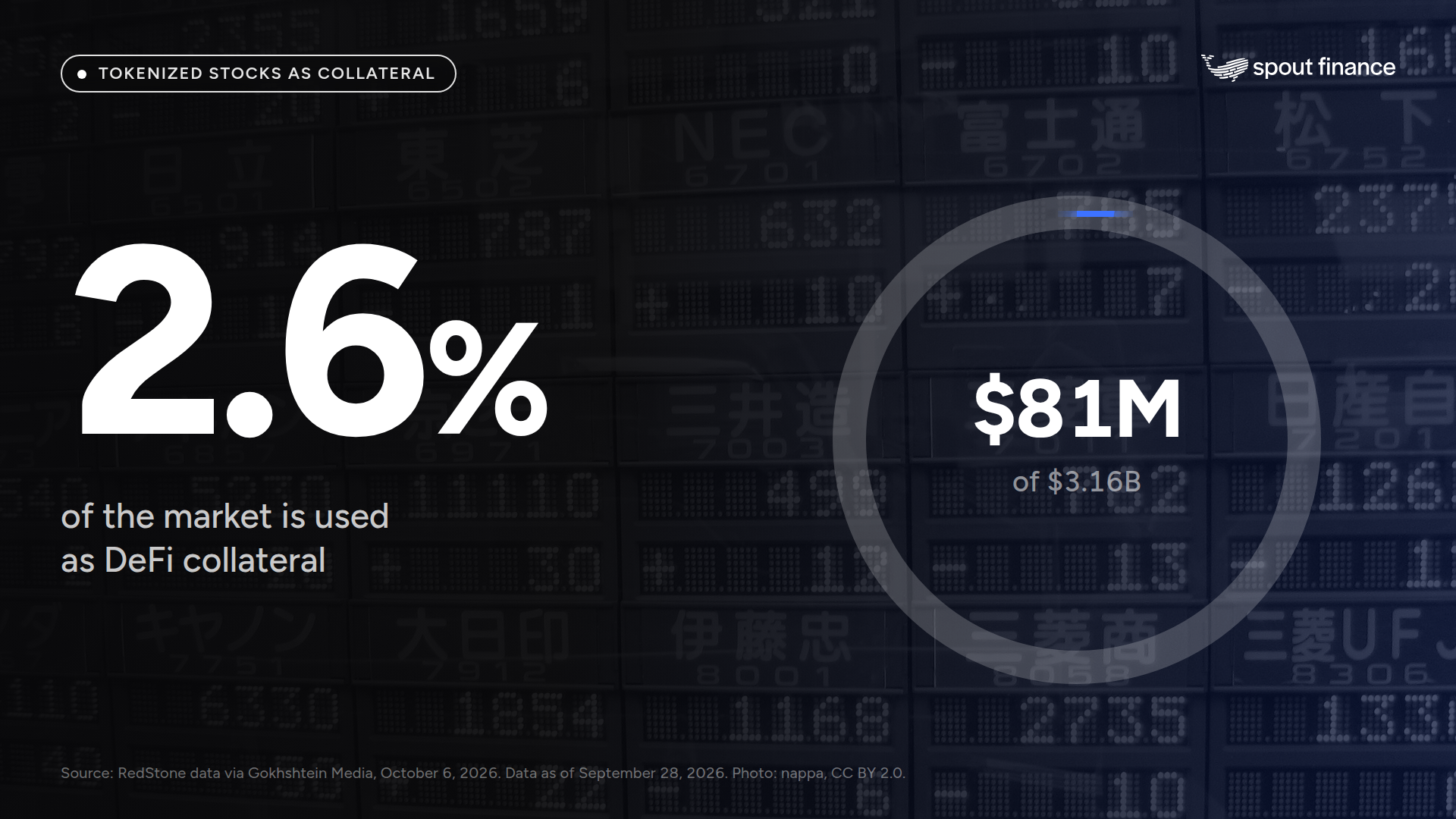
RedStone data reported on October 6 estimated that $81 million of the $3.16 billion tokenized-stock market was being used as DeFi collateral as of September 28. That is roughly 2.6% of the total.
 The distinction matters. A tokenized stock can be available to trade without being accepted as collateral by a lending protocol. Even when it is accepted, that does not guarantee that users will borrow against it or that enough liquidity will be available to support larger positions.
This week’s developments put that distinction into focus. Securitize brought tokenized US stocks to Solana, Binance expanded its tokenized-stock collateral offering, and OKXICE and Formation outlined plans for tokenized securities venues. Other developments covered private-market exposure, lending products, settlement infrastructure and the regulatory treatment of tokenized assets.
The market is expanding across several fronts, but access, collateral use and actual borrowing activity remain different measures of progress.
How big the tokenized-stock market is this week
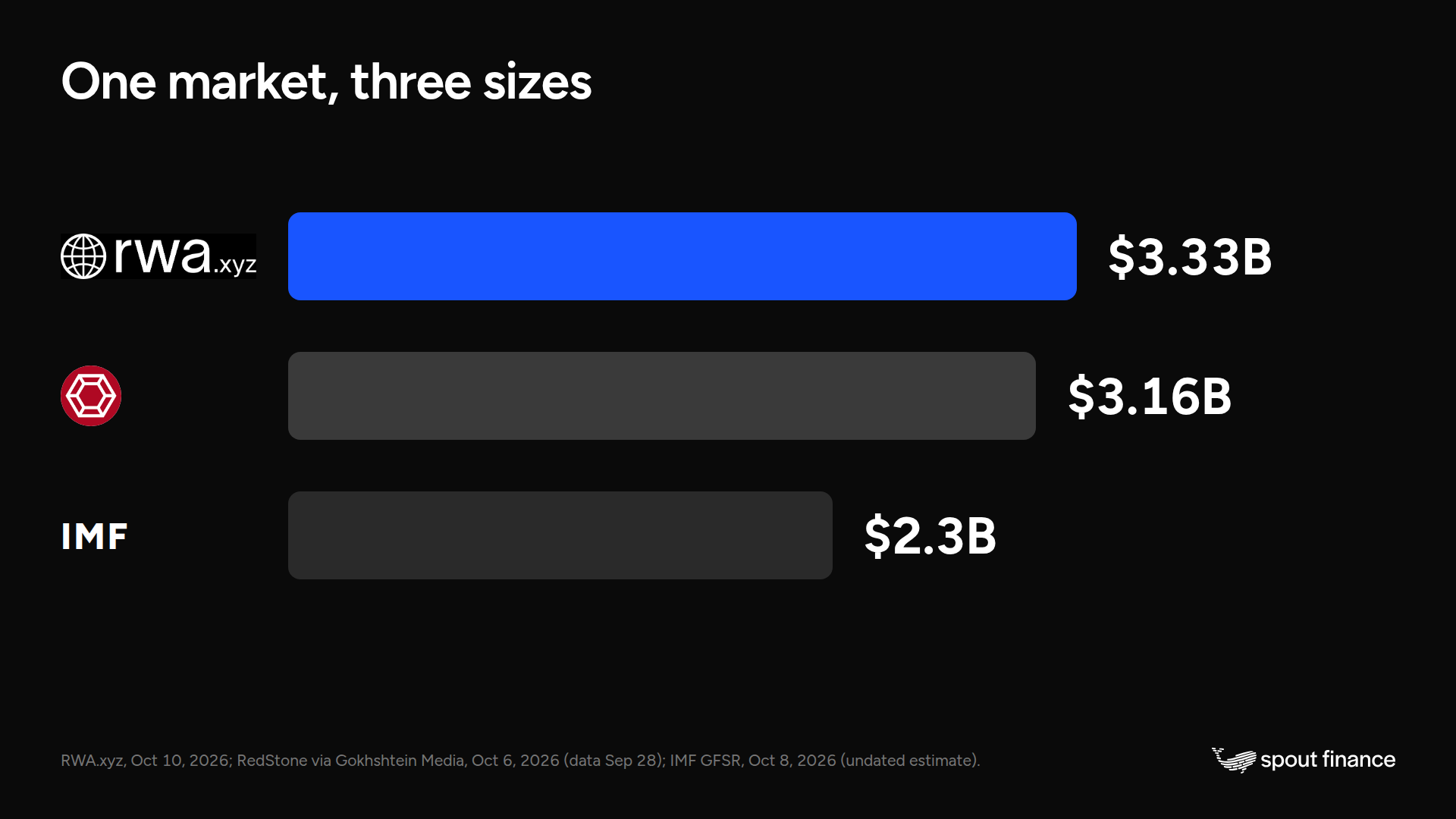
RWA.xyz valued distributed tokenized stocks at $3.33 billion on October 10, a 16.2% increase over 30 days. The platform recorded 4.34 million holders.
Ondo ranked first by issuer value at $924.5 million, narrowly ahead of Binance’s bStocks at $922.6 million. xStocks followed at $594 million and Securitize at $426.3 million. Securitize’s newly launched Solana stock tokens did not appear to be included in that snapshot.
Market totals differ across data providers because their methodologies and asset coverage are not identical. The International Monetary Fund put the tokenized-equity market at approximately $2.3 billion in its October Global Financial Stability Report. Some outlets have published higher totals without identifying their underlying data source.
These figures should not be treated as direct comparisons without accounting for the assets, definitions and dates each source uses.
New trading venues are taking shape
OKXICE publishes its tokenized securities venue notice
On October 4, OKXICE LLC published a notice outlining its proposed Tokenized Securities Venue under the SEC’s existing Innovation Exemption.
The venture is owned equally by Intercontinental Exchange Holdings, the parent company of the New York Stock Exchange, and OKC USA Holding. Its notice listed 63 symbols across 62 issuers, with Alphabet represented twice through GOOGL and GOOG.
The proposed venue would pair tokenized securities with USDC, USDG or USDT in permissioned Uniswap v4 pools on OKX’s X Layer. Access would be controlled through an OKXICE TSV Hook and a KYC soulbound token.
According to the notice, an unnamed tokenization provider would hold the underlying shares on a 1:1 basis through an SEC-registered broker-dealer that is a FINRA member.
On October 8, OKXICE revised the notice to include objections from Cerebras, AppLovin, Applied Digital and Rocket Lab. The revised version no longer included the explicit symbol list.
The notice is not SEC approval or registration. Based on the exemption’s 30-day notice requirement and the original October 4 publication date, November 3 would be the earliest possible operating date. OKXICE has not announced a launch date.
The issuer objections also raise questions about how the proposed venue will handle companies that do not want their shares tokenized and what registrations the venue operator will need. Those questions remain unresolved.
Orca and Loopscale combine under Formation
On October 7, Solana trading platform Orca and lending protocol Loopscale announced that they were merging into Formation, a New York company led by Luke Truitt as CEO, Mary Gooneratne as COO, and Christopher Montagano as Chief Strategy and Legal Officer.
Orca’s decentralized exchange and Loopscale’s lending products are expected to continue operating as they do now. ORCA will become Formation’s token, while Loopscale will not launch a separate token.
Formation also plans to pursue the licenses needed to operate a tokenized securities venue under the SEC’s Innovation Exemption. The company has identified artificial intelligence, energy, robotics and defense as sectors of interest.
Formation says it is already working with Figure, Shinhan Asset Management, Superstate, R3 and Securitize. It has not disclosed deal terms, and no venue filing was identified during the week.
The merger brings a trading business and a lending business under one corporate structure, alongside plans for a securities venue. Formation’s ability to operate under the exemption remains unresolved.
The restructuring also depends on an ORCA tokenholder vote. The vote was cancelled on October 8 and is scheduled to run again from October 11 to 16. The proposal would reduce xORCA’s share of fees from 40% to 10%, move approximately 14.2 million ORCA to a team account, and dissolve the Council. The consequences for the merger if the vote fails remain unclear.
Securitize brings tokenized US stocks to Solana
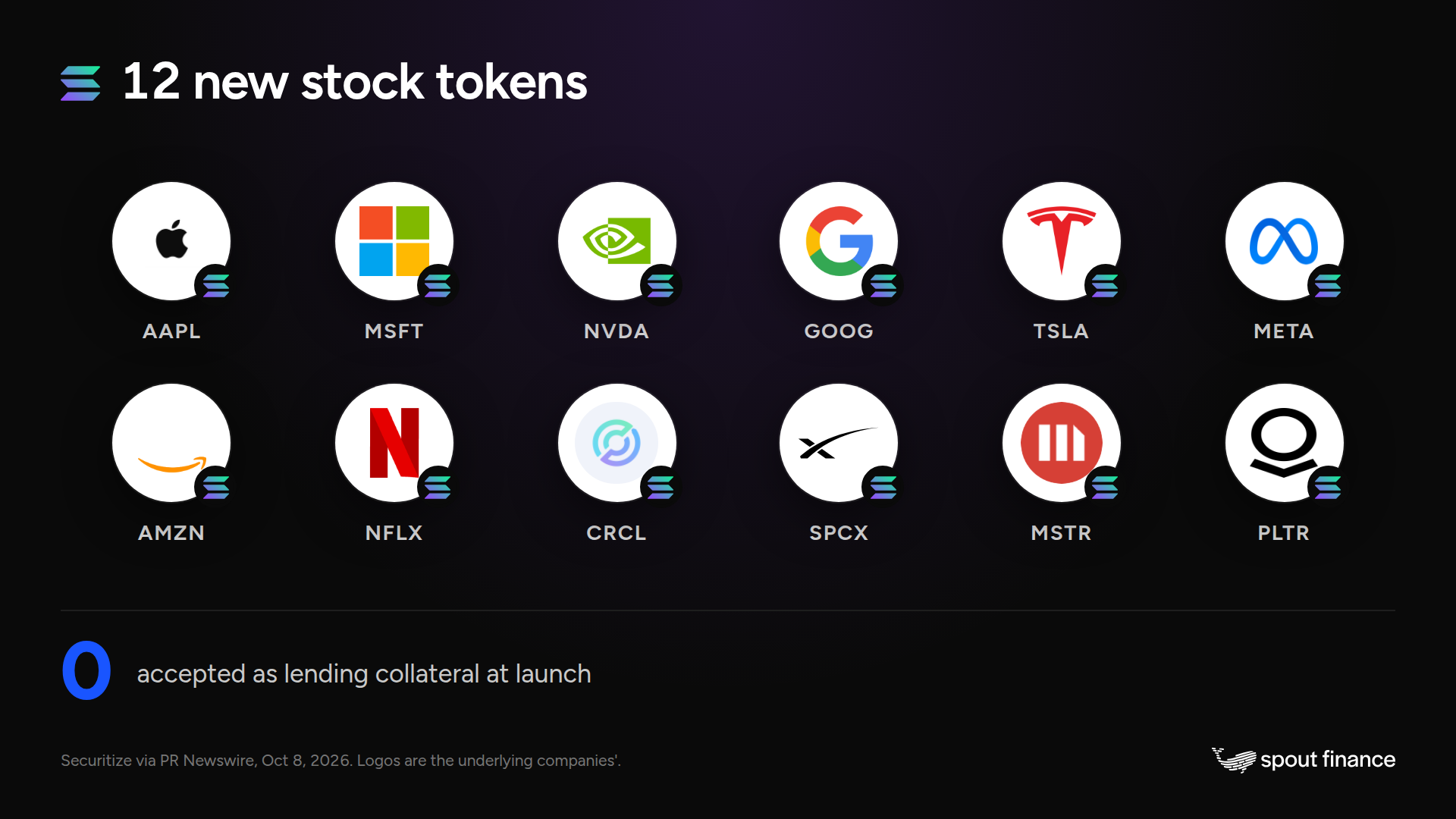
Securitize launched tokenized US stocks on Solana on October 8, offering 12 named assets: Apple, Microsoft, Nvidia, Alphabet, Tesla, Meta, Amazon, Netflix, Circle, SpaceX, Strategy and Palantir. SECZ is also trading.
The tokens are structured as security entitlements under Article 8 of the Uniform Commercial Code. Each is backed 1:1 by a share held through Securitize Markets LLC, a FINRA-registered broker-dealer and SIPC member. Securitize says the backing shares are not lent out.
Holders receive dividends and voting rights where the underlying share class provides them. They are not registered shareholders unless they convert their entitlements. GOOG, for example, represents Alphabet’s non-voting share class.
Trading takes place through Securitize’s proprietary Solana PropAMM. Jump Trading acts as market maker, RQD handles clearing and custody, and transactions settle in USDC. Trading began with extended hours, while 24/7 trading is planned.
Investors in the US, EU and other permitted jurisdictions can access the offering subject to KYC requirements and Securitize’s eligibility rules.
The launch does not mean these stocks can already be used throughout DeFi. No lending protocol accepted the tokens as collateral at launch. Securitize named Aave as a market the assets are designed to support over time, not as an existing integration. No trading-volume or holder figures were published.
 Securitize reported approximately $5 billion in platform assets under management as of September 2026. There is also a ticker discrepancy: its website lists GOOGL, while the launch announcement lists GOOG.
The launch adds another route for eligible investors to access tokenized stocks on Solana. Lending integration remains a separate step.
Backpack adds more assets to its Solana offering
On October 5, Backpack Securities listed the iShares MSCI Brazil ETF, EWZ, on Solana. The token is redeemable 1:1 through Backpack Exchange.
Altcoin Buzz also reported that Backpack added tokenized Cerebras stock, CBRS, on October 6. No primary announcement from Backpack was identified for that listing.
The reported Cerebras listing is notable because Cerebras was also among the companies that objected to OKXICE’s proposed tokenization of its stock.
The two developments highlight different parts of the tokenized-equity market: platforms are adding assets, while questions around issuer participation and the rights attached to tokens remain relevant.
Private-market exposure takes another form
Ondo launches Ondo Private Markets
Between October 5 and 8, Ondo introduced Ondo Private Markets, with its first market going live on October 8.
The product uses tokenized notes linked to private-company valuations. These notes are obligations of their issuer, not shares in the companies they reference. They do not provide ownership or shareholder rights.
Payouts are tied to the per-share value at a qualifying liquidity event. These events include a public listing followed by six months, an acquisition, insolvency, or the passage of ten years.
The product is available only to non-US persons. The first market was reported as a note referencing OpenAI, with ticker OPAIPon. Ondo explicitly states that OpenAI is not affiliated with or endorsing the product.
Ondo’s blog reported $3.9 billion in total value locked, while its press release gave a figure of $3.7 billion. Both are company-reported figures, and neither was accompanied by a date for the measurement.
The distinction between valuation exposure and share ownership is important here. A tokenized product can reference a private company without giving its holder shares or the rights that come with them.
Assetera expands access to Ondo’s tokenized stocks
On October 7, Assetera announced that it had listed more than 100 Ondo tokenized US stocks and ETFs for investors across the European Economic Area.
Assetera expects to expand access to Ondo’s catalog of more than 450 products during the fourth quarter of 2026.
The relationship predates this announcement. Assetera listed Ondo’s OUSG product in February 2025, making the latest development an expansion of an existing relationship.
Separately, 1exchange said it would explore listing Ondo Stocks. The announcement did not indicate endorsement, approval, partnership or participation by Ondo Finance.
The two developments are at different stages: Assetera has listed more than 100 products, while 1exchange is exploring a possible listing.
DigiFT lists a tokenized Treasury fund interest
Blockhead reported on October 6 that DigiFT had listed tokenized interests in a Fidelity US Treasury money market fund for institutional and accredited investors.
The report did not identify the fund by its full name or specify the blockchain and exact token structure. Those details have not been established from the available reporting.
The reported listing adds another example of traditional money-market exposure being represented through a tokenized financial product.
DGLD brings Swiss gold to Solana
DGLD, a Swiss gold token from Gold Token SA associated with MKS PAMP, went live on Solana through SwissBorg on October 5. Solana Compass reported that Arrakis liquidity was routed through Jupiter.
Gold-backed tokens represent a different type of real-world asset from tokenized equities. Their value is tied to gold rather than company shares, while backing, redemption arrangements and market liquidity remain important to how they function.
Lending and collateral: where tokenized stocks are being used
Only a small share of tokenized stocks is being used as DeFi collateral
RedStone data, reported by Gokhshtein Media on October 6, put the tokenized-stock market at $3.16 billion as of September 28. About $81 million of that amount was posted as DeFi collateral, or roughly 2.6% of the market.
The reported breakdown was:
- xStocks on Kamino and Jupiter Lend: $43.8 million
- Kamino Opening Bell: $25.4 million
- bStocks on Lista: $7.7 million
- Frankencoin: $4.2 million
- Morpho: approximately $1,400
These figures are reported estimates and were not independently verified directly with RedStone.
The distribution shows that tokenized-stock collateral is concentrated in a small number of markets. Although more platforms are listing these assets, the amount being used as collateral remains small relative to the overall tokenized-stock market.
For lending markets to support more of this activity, assets need dependable pricing, sufficient liquidity and workable redemption arrangements. Listing a token is only one part of that process.
Kamino opens an apyUSD borrowing market
On October 6, Kamino opened a market where users can post apyUSD as collateral and borrow USDC at up to 70% loan-to-value.
Kamino’s description says the reserve is backed mainly by preferred equity in public digital-asset treasury companies, including Strategy’s STRC.
This is equity-adjacent collateral, not tokenized common stock. Preferred equity carries a different claim structure from ordinary shares, so the two should not be treated as interchangeable.
The market expands the range of assets that can support borrowing on Solana, but it is distinct from a market that accepts tokenized common shares directly.
Binance adds four more bStocks as margin collateral
On October 7, TokenPost and The Defiant reported that Binance had added JPMB, LLYB, SECZB and USDEB to its Cross Margin, Portfolio Margin and Portfolio Margin Pro collateral offerings.
The assets have a 50% collateral ratio. Binance’s own announcement page was not accessible during the research period, so the details are based on secondary reporting.
The change gives eligible users more tokenized-stock collateral options within Binance’s centralized exchange margin system. It does not mean users can borrow the tokens themselves, nor does it establish that DeFi lending protocols accept them.
Block Street announces Aqua
On October 7, Block Street announced Aqua, a system designed to route liquidity across tokenized-stock issuers, including Binance bStocks and Bitget.
Aqua’s lending and collateral layer is still in development. Block Street reported more than $350 million in routed volume, a figure supplied by the company.
The planned lending features are aimed at a fragmented market. Tokenized stocks are spread across different issuers and platforms, and bringing liquidity together could make it easier to use these assets across borrowing and trading products. The lending functionality, however, should not be treated as live while it remains under development.
Stock-backed borrowing on Base: capacity versus use
At TOKEN2049 on October 7, Aave founder Stani Kulechov discussed the possibility that lending against tokenized stocks and other real-world assets could surpass lending against native crypto assets the following year. This was reported as a paraphrase, not a direct quote.
On October 9, Kulechov also posted about the growth of earning opportunities on tokenized stocks through Aave on Base.
As of October 10, Aave’s Base Equities Hub had approximately $10.04 million supplied, including about $4.76 million in tokenized-stock collateral. USDC borrowing stood at $1.55 million against a $21 million borrowing cap, with a reported borrowing APY of 1.31%.
Borrowing was therefore about 7% of the available cap in that snapshot. The cap shows how much the market permits users to borrow, not how much demand currently exists.
The distinction is useful when assessing tokenized-stock lending. A protocol may support an asset as collateral without that asset generating substantial borrowing activity. Collateral supplied, borrowing demand and the market’s capacity are separate measures.
Aave proposes USAT for Ethereum lending markets
On October 9, Aave Labs proposed adding Tether’s USAT to Aave V3 Core and the V4 Core Hub on Ethereum.
The proposal remains at the ARFC discussion stage. It is separate from Aave’s tokenized-equity markets: it concerns which asset can be borrowed, rather than adding a new tokenized stock as collateral.
Regulation and market infrastructure
The SEC’s custody proposal enters the public comment stage
The SEC’s proposed custody rules appeared in the Federal Register on October 6 under File S7-2026-35, at 91 FR 63870.
The proposal explicitly includes tokenized securities in its definition of crypto assets. The deadline for public comments is December 7, 2026.
The final treatment of tokenized equities under the rules remains unsettled. The framework could affect how platforms hold these assets and structure custody arrangements.
ESMA seeks evidence on tokenized clearing collateral
On October 9, the European Securities and Markets Authority opened a call for evidence on tokenized collateral used by central counterparties under EMIR.
The consultation considers digital-twin, natively issued and hybrid tokenization models. Responses are due January 15, 2027.
The consultation concerns institutional market infrastructure, not just retail trading or DeFi lending. ESMA is examining how tokenized assets could fit into the systems institutions use to support clearing and settlement.
DTCC’s October launch is still unconfirmed
DTCC said in May that its tokenization service would launch in October 2026. As of October 10, it had not announced a launch, and its tokenization page continued to say the service was coming later in the year.
Two secondary outlets reported that the service had gone live, but neither cited a DTCC source. Without confirmation from DTCC, the launch should be treated as unconfirmed.
Solana introduces delivery-versus-payment infrastructure
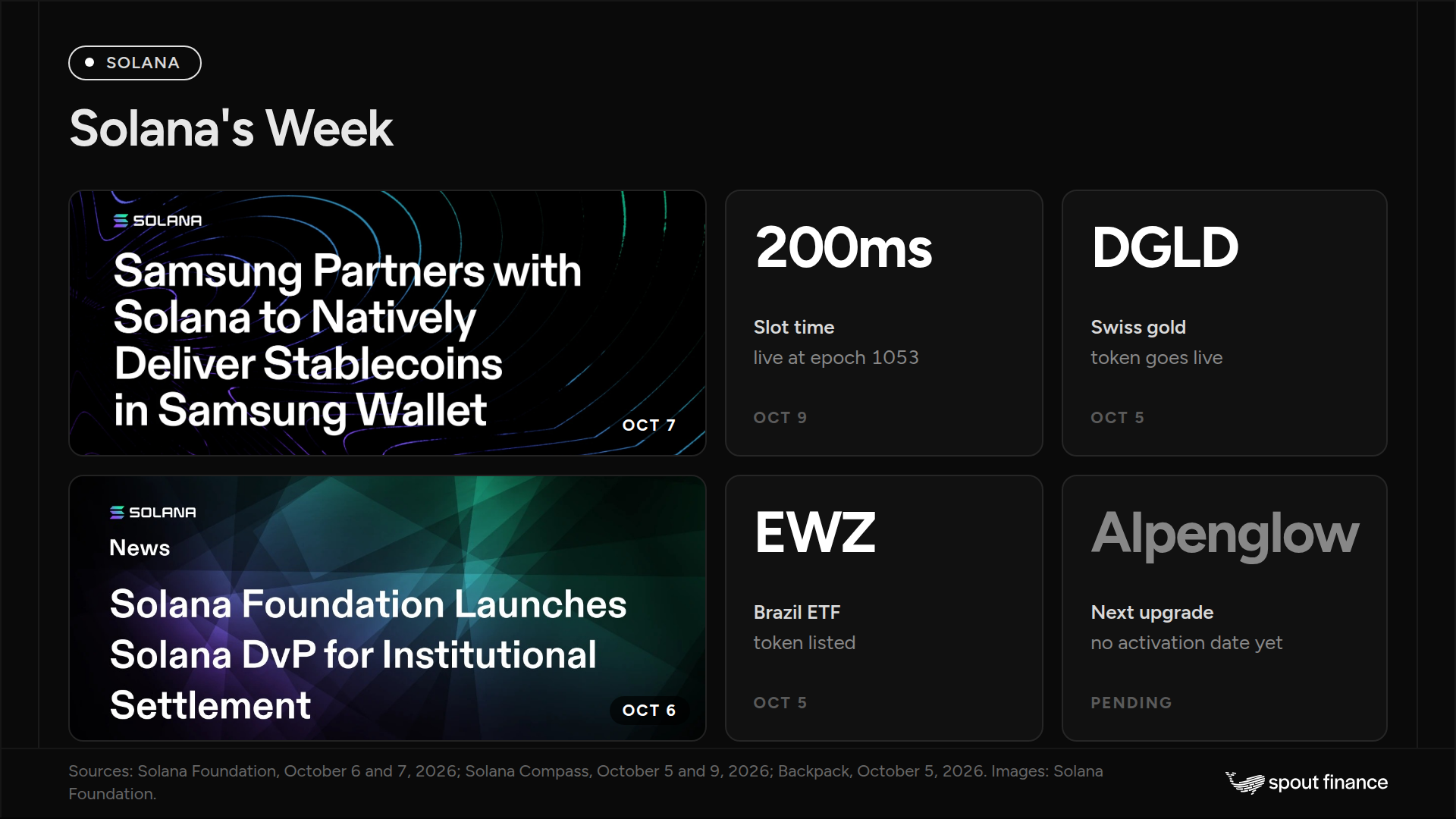
On October 6, the Solana Foundation launched Solana DvP, an open-source atomic delivery-versus-payment escrow program.
The program supports SPL tokens and Token-2022 extensions used by regulated issuers. J.P. Morgan contributed design input but did not endorse the product.
The announcement did not name any auditors or supported asset classes.
Delivery-versus-payment links an asset transfer to its payment so that both settle together or neither does. For tokenized securities, this can help coordinate the exchange of assets and funds between parties.
Solana DvP adds another settlement tool to the network’s tokenization infrastructure. Its adoption will depend on implementation, integrations and issuer requirements.
Solana Summit Singapore puts tokenization on stage
The October 6 Solana Summit in Singapore featured sessions on the “Tokenization Supercycle,” tokenized securities in crypto portfolios, and “Tokenization Is Easy. Liquidity Is Hard.”
Speakers from Loopscale and Orca appeared a day before their merger was announced. Spout co-founder and general counsel Paul Jan Reijn was also among the speakers.
At the invite-only Solana Capital Forum that day, Kamino said its collateral now spans tokenized real-world assets, credit funds, reinsurance and tokenized equities.
Solana’s transaction speed improves
Solana’s 200-millisecond slot time went live at epoch 1053 on October 9, according to Solana Compass, citing Anza.
This change is separate from Alpenglow. The upgrade has been described as coming to mainnet-beta soon, and an integrator guide pointed to mid-October. However, no activation epoch had been announced by October 10. Jito published validator requirements on October 9.
The distinction is straightforward: the slot-time change is live, while Alpenglow remains an upcoming upgrade.
Samsung Wallet prepares Solana stablecoin support
On October 7, the Solana Foundation announced that Samsung Wallet would support stablecoins on Solana. USDC cross-border transfers for US users were expected to begin in the final week of October.
The announcement extends Solana’s consumer-facing payment plans beyond trading and investment products.
CFTC issues new notices on leveraged crypto products
On October 5, the Commodity Futures Trading Commission issued an advance notice of proposed rulemaking on retail leveraged crypto transactions, alongside a no-action letter covering perpetual-style index futures.
Neither announcement specifically addressed tokenized securities. Both form part of the broader regulatory environment for crypto-based financial products.
IMF examines tokenized equity concentration
On October 8, the International Monetary Fund published a chapter on tokenization in its Global Financial Stability Report.
The chapter said Ondo Finance and Backed Finance represented more than 70% of tokenized equity value in its dataset, with products aimed mainly at investors outside the United States. It also described the two largest issuers as using synthetic models that provide economic exposure without direct legal ownership.
The IMF estimated the tokenized-equity market at about $2.3 billion, although the passage did not specify the date of that estimate. An accompanying IMF blog said roughly 80% of tokenized-equity trades were smaller than one share.
The IMF’s figures use their own definitions and measurement periods. They are not directly comparable with RWA.xyz’s $3.33 billion snapshot.
Franklin Templeton discusses tokenized fund trading with the SEC
TokenPost reported that Franklin Templeton met with the SEC Crypto Task Force on October 9 to discuss relief that could allow tokenized money market funds and ETFs to trade on Tokenized Securities Venues.
No SEC meeting memo was identified during the research period, so the account remains based on secondary reporting.
At TOKEN2049 on October 7, Franklin Templeton CEO Jenny Johnson also criticized tokenized funds that act as digital twins of existing fund structures. Crypto Briefing reported that she cited a $1.13 transaction cost for a Benji transaction compared with about $150 through traditional processes, using Franklin Templeton’s own figures.
Her comments focus on a practical question for tokenized funds: does putting an existing product onchain deliver operational benefits, or does it reproduce the same structure in a different format?
Nasdaq points to the collateral opportunity
Quartz’s October 9 paraphrase of CNBC reported that Nasdaq CEO Adena Friedman said tokenizing Treasuries, equities and money market funds could release tens of billions of dollars in trapped collateral.
Nasdaq did not announce a new tokenization product.
The use case she described is institutional: making collateral easier to transfer and use across financial markets.
More platforms move into tokenized stocks
On October 8, Tron founder Justin Sun said Tron planned to launch tokenized stocks and US Treasury products in the fourth quarter of 2026. No launch date, asset list or product structure was provided. The claim appeared in secondary outlets rather than an announcement from Tron.
Robinhood was also reportedly exploring a stock token linked to an actively managed ETF with T. Rowe Price. The discussions were described as preliminary.
Activity on Robinhood Chain has cooled. Daily transactions averaged 6.2 million from October 2 to 8, down 42% from the 10.8 million average between September 10 and 16. CoinDesk calculated the figures using growthepie data. The decline followed the end of Robinhood’s 90-day gas rebate on September 29.
On October 9, Base creator Jesse Pollak said tokenized stocks on Base were trading between $70 million and $100 million per day. He said 50 stocks were available, with 250 expected by month-end. The Block reported these figures without citing a data source.
On October 10, Enso went live on Robinhood Chain with routing into Stock Tokens. The company reported about $17 million routed, around 30% of which involved Stock Tokens.
These figures come from company statements and secondary reporting, rather than a single independently verified dataset. Their sources and levels of confirmation differ, so they should not be treated as directly comparable measures of market activity.
Macro conditions and onchain yields
The 13-week US Treasury bill coupon-equivalent yield rose five basis points, from 4.11% on October 2 to 4.16% on October 9.
The Federal Reserve released minutes from its September 15 to 16 meeting on October 7. The meeting ended with a 25-basis-point rate increase, taking the federal funds target range to 3.75% to 4.00%. The minutes indicated that another increase by year-end would likely be appropriate and that participants generally saw inflation risks tilted to the upside.
Federal Reserve Governor Michelle Bowman spoke on October 6, and Governor Christopher Waller spoke on October 8. The next Federal Open Market Committee meeting is scheduled for October 27 to 28. September CPI data is due October 14. No CPI or payrolls release fell within this roundup’s reporting period.
How onchain yields compare
The following rates were recorded on October 10, except where another date is specified. They can change with market conditions.
- Aave V3 Ethereum USDC: Supply reached 3.87% APR on October 10, up from 3.69% the previous week. This was approximately 29 basis points below the Treasury bill yield.
- Sky Savings Rate: The rate rose from 3.60% to 3.80% between October 6 and 7, leaving it around 36 basis points below the bill.
- Maple syrupUSDC: Reached 5.25% weekly APY, approximately 109 basis points above the Treasury bill.
- Ethena sUSDe: The staking yield was 4.75% on October 7, about 59 basis points above the bill.
Treasury yields, protocol APR and weekly APY measure different things, so the spreads are approximate rather than directly comparable.
The headline rate is only one part of a yield comparison. The underlying assets, market structure and mechanism generating the return also matter.
Solana ETF flows turn negative
Solana spot ETFs recorded net outflows on five consecutive days, from October 5 through 9.
The reported daily flows were:
- October 5: −$9.2 million
- October 6: −$3.7 million
- October 7: −$4.8 million
- October 8: −$3.5 million
- October 9: −$3.8 million
The five-day total was approximately $25 million in net outflows. BSOL accounted for a reported $21 million.
This followed a nearly flat week, when net flows were approximately $0.8 million.
What this means for Spout Finance
Despite the growth of tokenized stocks, their use as DeFi collateral remains limited. Only about $81 million of the $3.16 billion market was being used in lending, leaving much of that supply outside DeFi lending markets.
Securitize’s launch of tokenized US stocks on Solana adds more assets to the ecosystem, but those tokens were not accepted as lending collateral at launch. Aave’s Base Equities Hub offers a practical example of stock-backed borrowing in action. On October 10, it held about $4.76 million in tokenized-stock collateral, with $1.55 million borrowed.
For Spout, this presents an opportunity to help close the gap between holding tokenized stocks and putting them to work. Users can borrow stablecoins against their tokenized equities without selling their underlying exposure, at 0% interest.
The lending model matters too. Spout’s lender yield comes from covered-call premiums written against collateral, rather than token emissions or temporary borrowing incentives. This gives lenders a defined source of yield without relying on rewards to attract borrowing activity.
As more platforms bring tokenized equities onchain, making these assets available is only part of the equation. The next step is making them useful as collateral, giving holders a reason to borrow against them, and providing lenders with a clear source of returns.