What Are Tokenized Stocks and How Do They Work?
Guides
November 3, 2026
Learn what tokenized stocks are, how they work, how traditional shares are represented on a blockchain, and how investors use tokenized equities.
Stocks have traditionally been bought, held, and traded through brokerage accounts and traditional financial markets.
Blockchain technology is introducing another way to represent these assets.
Through tokenization, traditional stocks can be represented by digital tokens recorded on a blockchain. These tokens are known as tokenized stocks or tokenized equities.
This brings traditional financial assets into blockchain-based infrastructure, allowing them to be transferred between compatible wallets and potentially used across different onchain financial applications.
But what exactly are tokenized stocks? How are they created, what do they represent, and how do they work?
Let’s break it down.
What Are Tokenized Stocks?
Tokenized stocks are digital tokens issued on a blockchain that represent or provide exposure to traditional company shares.
They are designed to track the value of publicly traded stocks, such as Apple, Microsoft, or Tesla, and can also represent exchange-traded funds (ETFs).
Unlike traditional stocks held through a brokerage account, tokenized stocks exist as digital assets that can be stored and transferred using compatible blockchain wallets.
For example, a tokenized version of Apple stock represents exposure to Apple’s publicly traded shares. Its price is designed to follow the value of the corresponding stock.
The token’s exact structure depends on its issuer. Some tokenized stocks represent an ownership interest in the underlying security, while others provide indirect or synthetic exposure to its price.
This distinction matters because owning a tokenized stock does not automatically give you the same shareholder rights as owning the traditional share directly.
How Do Tokenized Stocks Work?
Tokenized stocks connect traditional financial assets with blockchain infrastructure.
The process generally involves an issuer, the underlying shares, a custodian, and a blockchain where the tokens are created and transferred.
Here’s how a common custodial tokenization model works.
1. The underlying shares are purchased
A token issuer first acquires the traditional shares through a broker.
For example, if an issuer wants to create tokens representing Apple stock, it purchases the corresponding shares through a brokerage account.
2. The shares are held with a custodian
The purchased shares are held by a custodian in an account under the issuer’s arrangement.
The custodian holds the underlying securities, while the issuer manages the tokens representing them.
This arrangement connects the digital tokens to the traditional financial assets.
3. The issuer creates tokens on a blockchain
The issuer creates digital tokens that represent the underlying shares or the relevant interest in those shares.
These tokens are recorded on a blockchain and distributed to buyers.
For example, an issuer holding 1,000 Apple shares may issue tokens representing interests in those shares, according to its token structure and issuance terms.
Some tokenized stocks also support fractional amounts, allowing users to hold less than one whole share.
4. The tokens can be transferred between wallets
Once issued, tokenized stocks can be held in compatible blockchain wallets and transferred between supported addresses.
Unlike traditional brokerage transfers, which follow brokerage and market infrastructure, blockchain transfers are recorded directly on the network.
The exact transfer rules, available trading hours, and restrictions depend on the issuer and the blockchain.
5. Redemption follows the issuer’s terms
Depending on the token structure, holders may be able to redeem their tokens through the issuer.
In a custodial model, redemption generally involves destroying or returning the token and selling or delivering the underlying shares according to the issuer’s terms.
Not every tokenized stock offers the same redemption process.
What Are the Different Types of Tokenized Stocks?
Not all tokenized stocks are structured in the same way. The main difference is how the token connects to the underlying security and what rights it gives the holder.
There are three common models.
1. Issuer-Sponsored Tokenized Stocks
In this model, the company that issues the original security, or an authorised agent, issues the security directly in tokenized form.
The blockchain becomes part of the system used to record ownership and transfers.
Depending on the security class and its terms, holders can receive rights similar to those attached to traditional shares, including voting and dividend rights.
2. Custodial Tokenized Stocks
In a custodial model, a third-party issuer purchases the underlying shares and holds them through a custodian.
It then issues tokens representing an ownership interest or security entitlement connected to those shares.
The token holder’s rights depend on the legal and custody arrangements behind the token.
This model connects traditional securities held through financial intermediaries with blockchain-based ownership records.
3. Synthetic Tokenized Stocks
Synthetic tokenized stocks provide exposure to the price movements of a traditional stock without necessarily representing ownership of the underlying shares.
For example, a synthetic token designed to track Tesla stock may increase or decrease in value as Tesla’s market price changes.
However, the holder may not have ownership rights, voting rights, or claims against the company whose stock the token tracks.
Instead, the rights and obligations depend on the financial arrangement with the token issuer.
Understanding which model a token uses is important before acquiring or using it.
What Is the Difference Between Traditional Stocks and Tokenized Stocks?
Both traditional and tokenized stocks provide exposure to publicly traded companies, but they differ in how they are issued, held, and transferred.
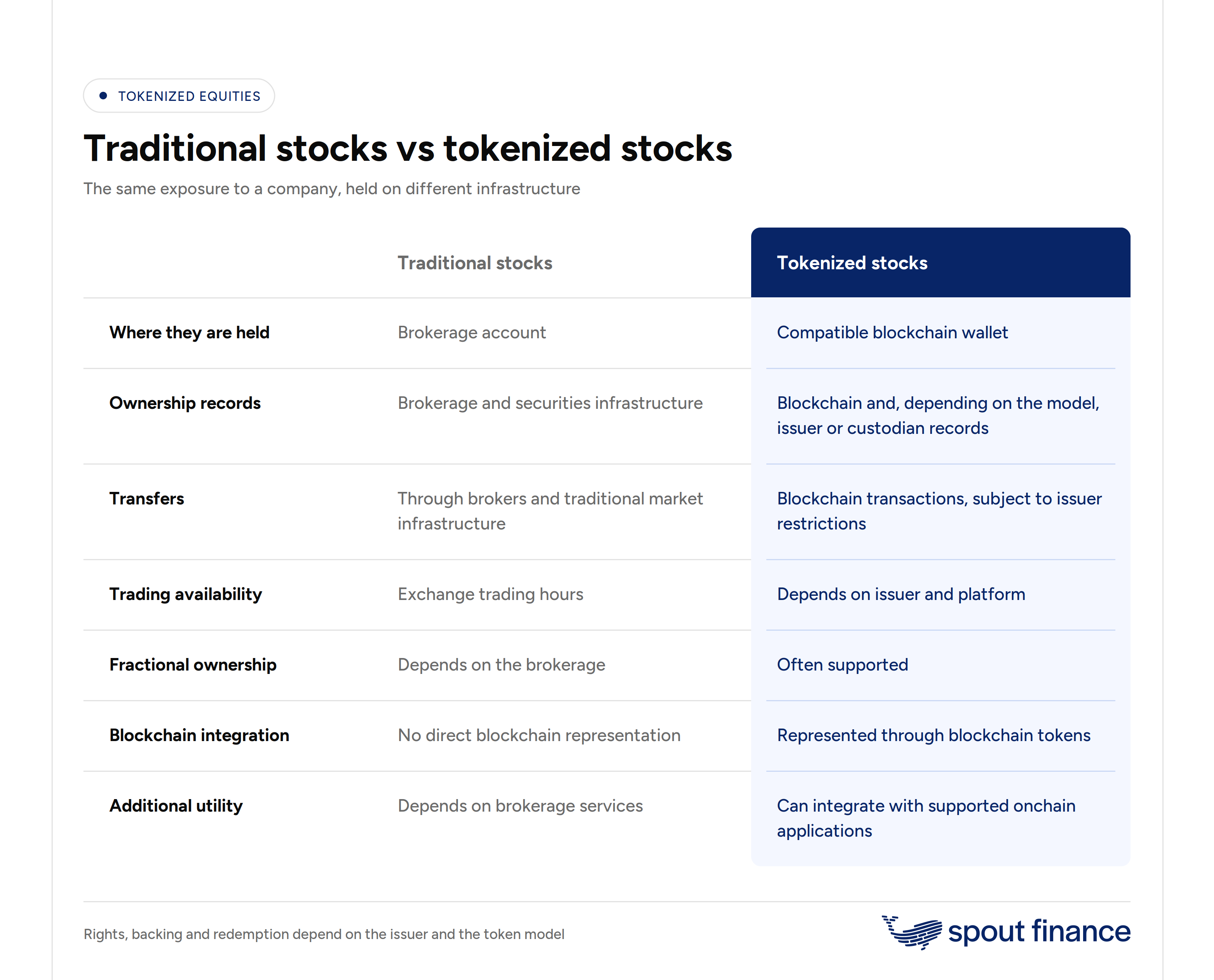 The key difference is the infrastructure used to represent and manage the asset.
Tokenization introduces blockchain-based ownership records and transfer mechanisms, while the underlying financial rights still depend on the structure of the token.
What Can You Do With Tokenized Stocks?
Tokenized stocks can be used for more than holding exposure to traditional companies.
Their blockchain-based structure creates opportunities to integrate them into different financial applications.
Some possible uses include:
Holding and transferring assets
Users can hold eligible tokenized stocks in compatible wallets and transfer them to other supported addresses.
Trading tokenized equities
Depending on the issuer and platform, tokenized stocks can be bought and sold through supported blockchain-based markets.
Using tokenized stocks as collateral
Some onchain lending protocols accept eligible tokenized stocks as collateral.
This allows users to access funds against the value of their holdings rather than selling the assets outright.
Integrating with onchain financial products
Tokenized equities can serve as building blocks for financial applications that use blockchain infrastructure.
This creates opportunities for new ways to interact with traditional financial assets.
How Does Spout Work With Tokenized Stocks?
Spout is an onchain lending protocol on Solana that works with tokenized US stocks and ETFs issued by approved third-party issuers.
Spout does not issue its own tokenized stocks. Instead, it accepts eligible tokens that meet its issuer, technical, and asset requirements.
These tokenized equities can be used as collateral to access USDC through Spout’s lending model.
The protocol is designed to let borrowers access up to 50% of their eligible collateral value at 0% borrowing interest.
This gives tokenized stocks another use within onchain finance. Instead of serving only as digital representations of traditional equities, eligible tokens can also support access to liquidity.
The broader opportunity is to make traditional financial assets useful across more financial applications.
Why Are Tokenized Stocks Important?
Tokenization is changing how traditional financial assets can be represented and used.
By bringing securities onto blockchain infrastructure, tokenization introduces new ways to hold, transfer, and interact with assets.
It also creates opportunities for financial applications to work with assets that have traditionally remained within brokerage and institutional systems.
For investors, the significance goes beyond having a digital version of a stock.
The bigger opportunity is the development of financial products that give these assets additional utility.
As blockchain infrastructure and tokenized financial markets develop, tokenized stocks are becoming an important part of the conversation around the future of onchain finance.
Conclusion
Tokenized stocks represent a new way to bring traditional equities onto blockchain infrastructure.
They allow eligible financial assets to be represented as digital tokens, held in compatible wallets, and used across supported blockchain applications.
However, not all tokenized stocks work the same way. Their backing, ownership structure, shareholder rights, and redemption arrangements depend on the issuer and the model used.
As tokenization develops, the opportunity extends beyond representing traditional stocks onchain. It also creates room for new financial products built around these assets.
Learn more: Explore the Spout documentation to understand how eligible tokenized stocks work as collateral within onchain lending.
This article is for educational purposes only and does not constitute financial or investment advice.