How to Borrow Against Tokenized Stocks Without Selling
Guides
October 27, 2026
Learn how to borrow USDC against tokenized stocks without selling your holdings, how stock-backed borrowing works, and how Spout approaches onchain lending.
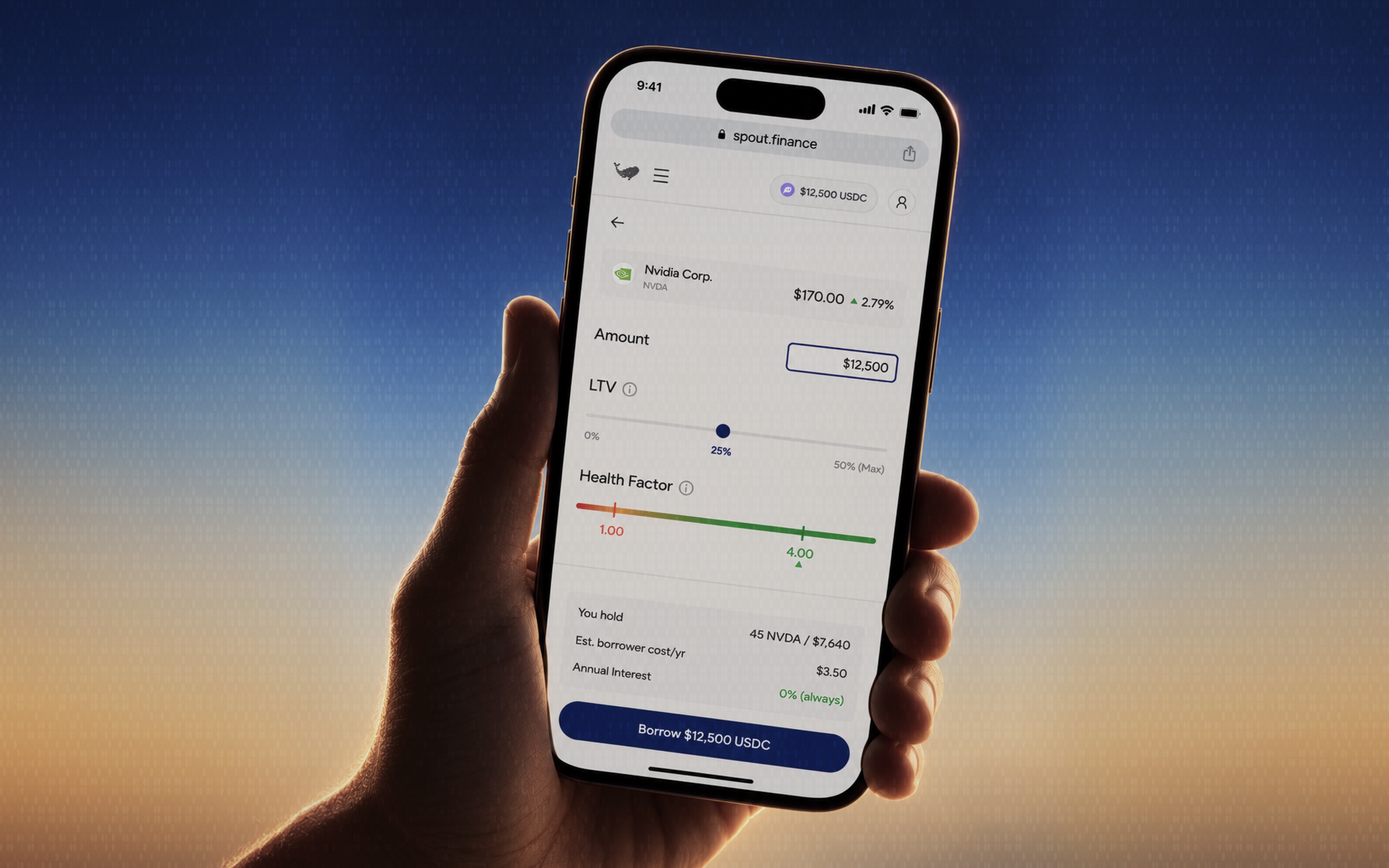
What if you need cash but do not want to sell the stocks you have been holding?
Selling investments is one way to access money, but it also means giving up some or all of your position. If you want to keep your exposure to the market, borrowing against your holdings offers another option.
This is the idea behind stock-backed borrowing. Instead of selling an asset to raise funds, you use its value as collateral for a loan.
The same concept is extending to tokenized stocks, bringing traditional equities onto blockchain infrastructure and creating new ways to use them within onchain financial products.
Spout is being built around this opportunity. On Solana, Spout is designed to let users borrow USDC against eligible tokenized US stocks and ETFs at 0% borrowing interest.
In this guide, we’ll explain what borrowing against tokenized stocks means, how the process works, and how Spout approaches it.
What Does It Mean to Borrow Against Tokenized Stocks?
Borrowing against tokenized stocks means using eligible blockchain-based tokens representing traditional equities as collateral to access a loan.
A tokenized stock is a digital token designed to represent or provide exposure to a traditional stock or exchange-traded fund (ETF). Its structure and the rights attached to it depend on the issuer.
Rather than selling your tokenized stocks, you deposit eligible assets into a lending protocol. The protocol uses their value to determine how much you can borrow.
For example, imagine you hold $20,000 worth of eligible tokenized stocks and need $5,000 for a personal expense or business opportunity.
You could sell part of your holdings to raise the money. Alternatively, a lending protocol may allow you to use those holdings as collateral and borrow USDC against them.
This gives you access to funds without having to sell the assets outright.
The amount you can borrow depends on the platform’s collateral requirements, loan-to-value limit, supported assets, and available lending liquidity.
How Does Borrowing Against Tokenized Stocks Work?
The process generally follows a few steps, although the exact experience varies by platform.
1. Hold eligible tokenized stocks
First, you need tokenized stocks that the lending protocol accepts as collateral.
Not every token representing the same company will necessarily be supported. Different issuers can offer different token structures and terms, so check the platform’s supported assets before proceeding.
2. Connect your wallet
On an onchain lending platform, you typically connect a compatible wallet that holds your tokenized stocks.
You may need the network’s native token to pay transaction fees, depending on the platform and the transactions involved.
3. Deposit your stocks as collateral
Choose the eligible tokenized stocks you want to use and deposit them according to the protocol’s instructions.
The platform assesses the value of your collateral and calculates your borrowing capacity. Instead of selling your holdings for cash, you use their value to support a loan.
4. Choose your borrowing amount
The protocol determines how much USDC you can borrow based on the value of your eligible collateral and its loan-to-value limit.
Loan-to-value, or LTV, is the percentage of your collateral value represented by your loan.
For example, if you deposit $20,000 worth of eligible tokenized stocks and borrow $5,000, your LTV is 25%.
LTV = Loan amount ÷ Collateral value × 100
A platform’s maximum LTV determines the upper limit of what you can borrow against your holdings.
5. Receive USDC
After you review the loan terms and confirm the transaction, the protocol provides the borrowed USDC according to its process.
You can then use the funds without needing to sell the tokenized stocks you deposited as collateral.
6. Repay and withdraw your collateral
When you repay the loan according to the protocol’s terms, you can withdraw the collateral as permitted by the platform.
This completes the borrowing process: use eligible tokenized stocks to access funds, repay the loan, and regain access to the assets.
How Much Can You Borrow Against Tokenized Stocks?
Your borrowing capacity depends on the value of the assets you deposit and the platform’s maximum LTV.
For example, if a protocol allows borrowing up to 50% of eligible collateral value, the calculation would look like this:
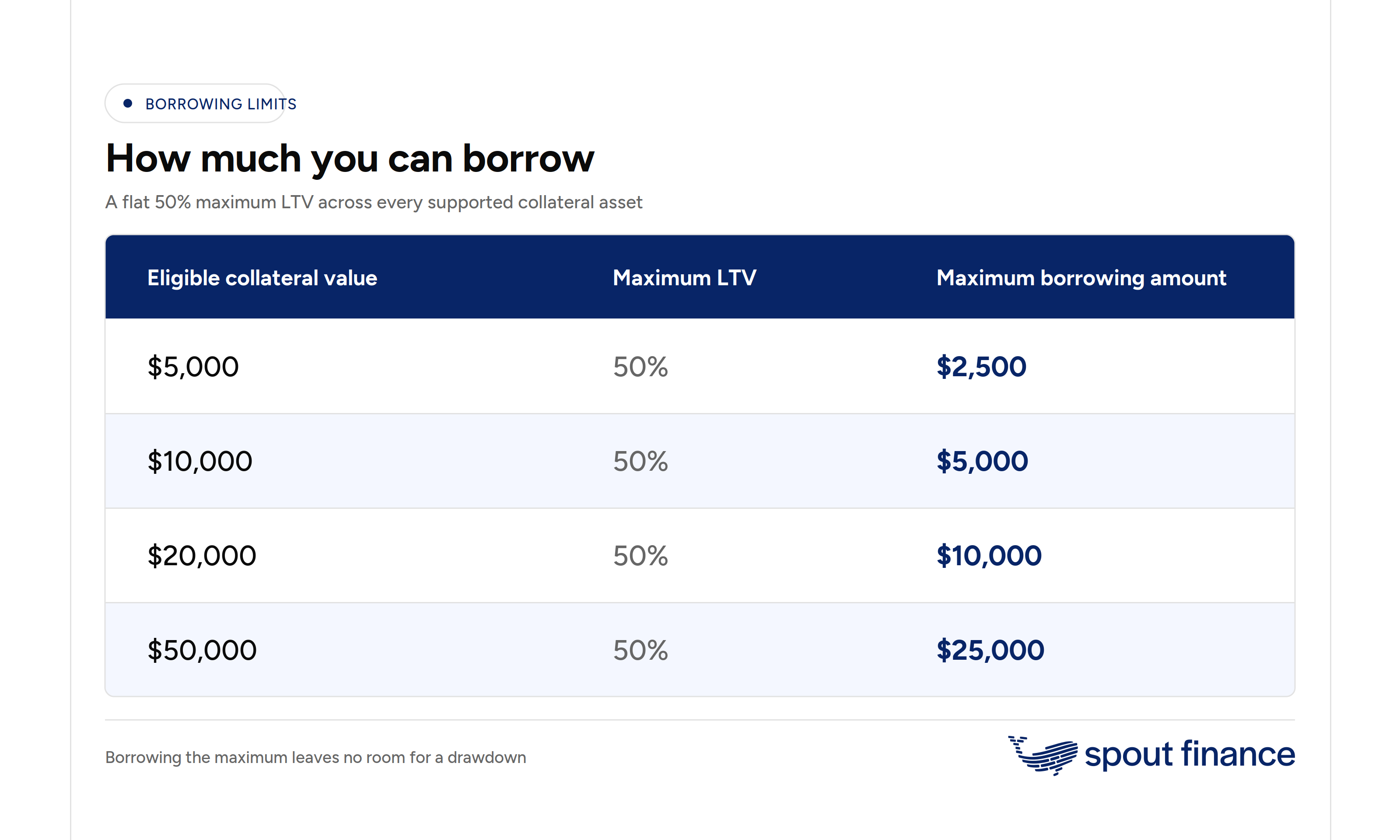 These figures illustrate how a 50% LTV works. Your actual borrowing capacity depends on the assets accepted and the protocol’s current terms.
Spout’s model is designed to let users borrow USDC against eligible tokenized US stocks and ETFs, with a maximum borrowing amount of 50% of eligible collateral value.
This means your holdings can serve another purpose beyond simply tracking the value of an investment. They can also support access to funds.
How Does Spout Approach Borrowing Against Tokenized Stocks?
Traditional stock-backed borrowing lets investors use securities as collateral rather than selling them. Spout brings this concept into an onchain lending model on Solana.
Spout is being built to let users deposit eligible tokenized US equities and ETFs as collateral and borrow USDC against their value.
Its approach has three key components.
Borrow USDC against eligible stocks
Users will be able to use supported tokenized stocks as collateral to access USDC, without needing to sell their holdings outright.
The protocol is designed around a maximum LTV of 50% of eligible collateral value.
Borrow at 0% interest
Spout’s model is designed to offer 0% borrowing interest.
Rather than relying solely on interest paid by borrowers to fund lender yield, the protocol uses a model in which covered-call premiums help generate income for lenders.
Connect stock-backed borrowing with onchain finance
Tokenization can make traditional financial assets usable within blockchain-based financial applications.
Spout is being built to give eligible tokenized equities another use: supporting access to USDC through onchain lending.
The broader goal is to make financial tools associated with traditional securities financing more accessible through onchain infrastructure.
Spout is still under development. Refer to the official documentation for the latest product details and availability.
Why Borrow Against Tokenized Stocks Instead of Selling Them?
The main appeal is straightforward: you can access funds without immediately giving up your position in an investment.
For someone who wants to maintain exposure to eligible stocks while meeting a financial need, borrowing can provide an alternative to selling.
Tokenized stocks add an onchain dimension to this process. When supported by a lending protocol, they can be used as collateral within blockchain-based financial infrastructure.
This creates a way for eligible tokenized assets to serve a practical purpose beyond representing exposure to traditional equities.
Conclusion
Borrowing against tokenized stocks offers an alternative to selling your holdings when you need access to funds.
The process involves depositing eligible tokenized stocks as collateral, borrowing against their value, receiving USDC, and repaying the loan according to the platform’s terms.
Spout is building an onchain lending protocol on Solana designed to let users borrow USDC against eligible tokenized US stocks and ETFs at 0% borrowing interest, with a maximum LTV of 50% of eligible collateral value.
As tokenized assets become part of more onchain financial products, stock-backed borrowing is one way those assets can be put to use beyond simply representing an investment.
Learn more: Visit the Spout documentation to explore how the protocol works and its approach to borrowing against tokenized stocks.
This article is for educational purposes only and is not financial, investment, legal, or tax advice.