Weekly Roundup: Tokenized Stocks Gain Ground as Lending and Regulation Take Shape
Market & Insights
October 17, 2026
Tokenized stocks are moving beyond trading into DeFi lending. This week’s RWA roundup covers stock-backed borrowing, institutional adoption, issuer resistance, and the latest developments shaping tokenized assets on Solana.

The tokenized-equity market continued to grow between October 12 and 17, but this week’s developments showed that the industry is entering a more complex phase. New platforms are expanding access to traditional stocks, financial institutions are testing tokenized assets in established markets, and lending protocols are experimenting with stock-backed borrowing. At the same time, questions about issuer consent, regulatory treatment, and the durability of borrowing demand are becoming harder to ignore.
This week, we announced a $2 million strategic round. Elsewhere in the market, Binance reported a new milestone for bStocks, while borrowing against tokenized stocks on Aave V4 increased sharply. Together, these developments point to an industry moving beyond issuance and toward the infrastructure needed to make tokenized assets useful across financial markets.
Tokenized Stocks Expand, but Access Comes in Different Forms
Several platforms expanded access to US equities this week, but the products do not all offer the same kind of exposure or onchain functionality.
On October 12, Bybit opened trading in more than 1,000 US stocks and ETFs to eligible non-US users. Transactions are paid in USDC, with trading available 24 hours a day, five days a week. The assets are executed and held through Alpaca, making this a brokerage-access product rather than a tokenized-stock offering.
That distinction matters as exchanges bring traditional financial products into crypto platforms. Access to stocks through a crypto account does not necessarily mean the assets can be transferred onchain, used as DeFi collateral, or traded through decentralized liquidity pools.
Bitget took a different approach on October 13 with its rToken Stock Transfer feature. Users can transfer more than 3,000 US stocks and ETFs from an external broker through a free-of-payment transfer to an Alpaca omnibus account, where the assets are converted into rTokens.
Bybit also announced plans for mStocks on October 13, a separate product involving 1:1 stock-backed tokens developed in collaboration with Mantle. Mantle is expected to host automated market-maker pools, with a launch targeted for November. The announcement did not confirm a launch date or provide full details about the token issuer.
TokenPost reported that EQX Labs was preparing 11 tokenized US stocks and ETFs as spot markets on Hyperliquid. The proposed assets use limited-recourse notes, with Alpaca, StoneX, and Clear Street named as custodians. The offering was not live as of October 14, and no launch date had been provided.
These launches reflect a broader push to make traditional equities available through crypto-native infrastructure. However, the products differ in their legal structures, custody arrangements, transferability, and potential use in lending. Those distinctions will become increasingly important as tokenized stocks move beyond trading.
bStocks Crosses $1 Billion as the Market Reaches $3.5 Billion
Binance announced on October 15 that its bStocks product had surpassed $1 billion in assets under management, approximately four months after its June 11 launch. The company also reported nearly 100 listings, more than $40 billion in cumulative trading volume, and $6 billion converted between direct stocks and bStocks. These figures were attributed to Binance and Dune data as of October 15.
The milestone coincided with another increase in the overall tokenized-stock market.
RWA.xyz data read on October 17 put distributed tokenized-stock value at approximately $3.50 billion, up 19.47% over 30 days. The number of holders reached 4.42 million, an increase of 17.94% over the same period.
Binance’s bStocks ranked first by value at approximately $1.2 billion, ahead of Ondo at $893.7 million and xStocks at $600.4 million. Securitize stood at $360.9 million, followed by Robinhood at $145.9 million and Reality at $142.8 million.
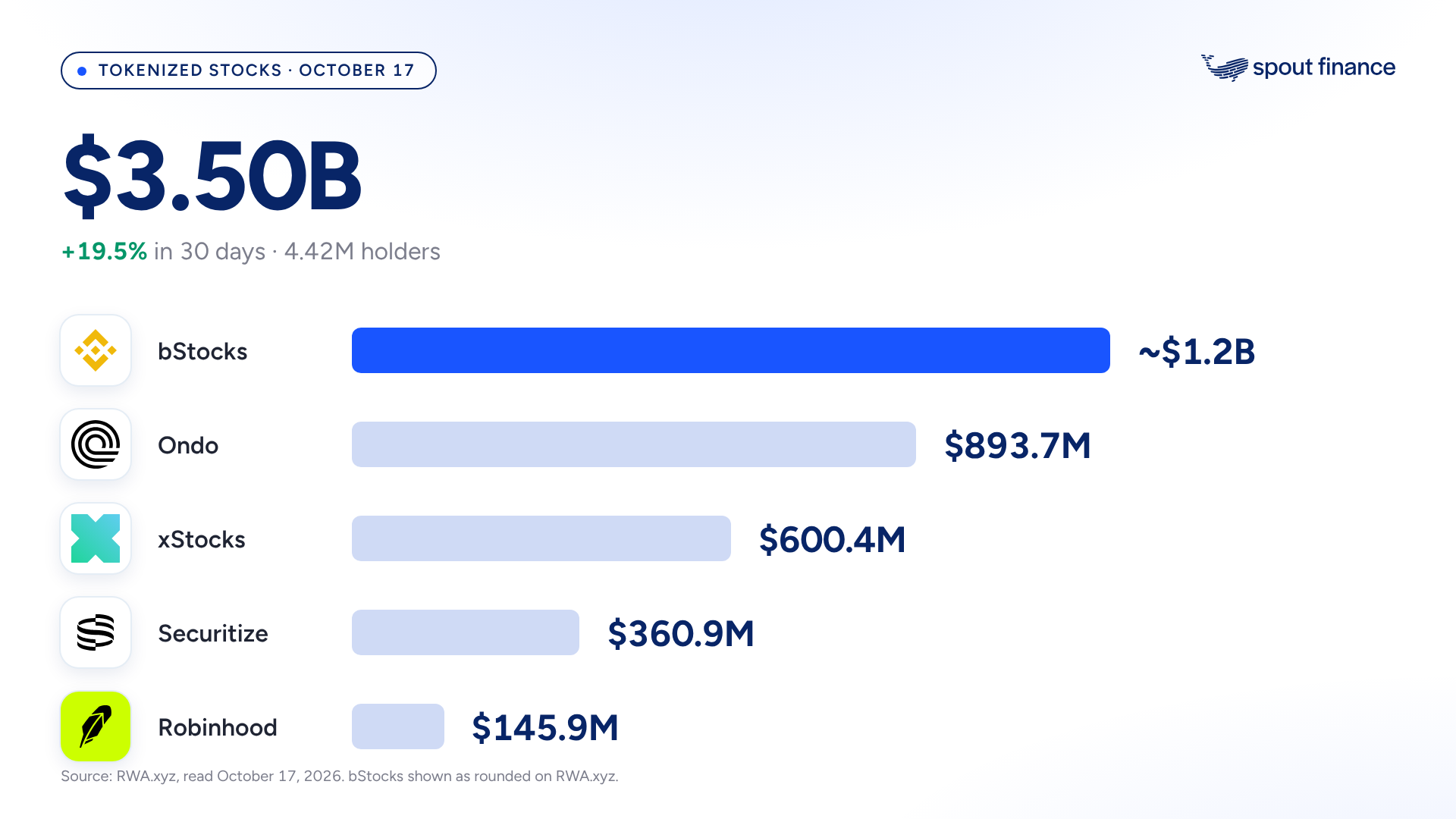 The ranking is notable because bStocks had been valued at approximately $922.6 million in the previous week’s RWA.xyz snapshot. Its reported growth places it ahead of Ondo in the current dataset. Securitize moved the other way, from $426.3 million on October 10 to $360.9 million, in the same week its tokenized stocks on Solana began trading.
Other estimates published on October 16 put the market at $3.8 billion for the week of October 5, according to figures attributed to DWF Labs. That estimate used different platform values from RWA.xyz, illustrating why market totals should be compared alongside their dates and methodologies rather than treated as interchangeable.
The Defiant also reported on October 12 that Robinhood’s Stock Tokens had reached $15 billion in cumulative trading volume and about 200,000 holders as Robinhood Chain passed 100 days. Robinhood had not published these figures itself, and no cut-off date was given.
The figures point to continued growth in tokenized equities.
Issuer Resistance Becomes a Bigger Part of the Tokenization Debate
Expansion has not been straightforward. This week brought further signs that companies whose shares are being tokenized may not support every arrangement involving their securities.
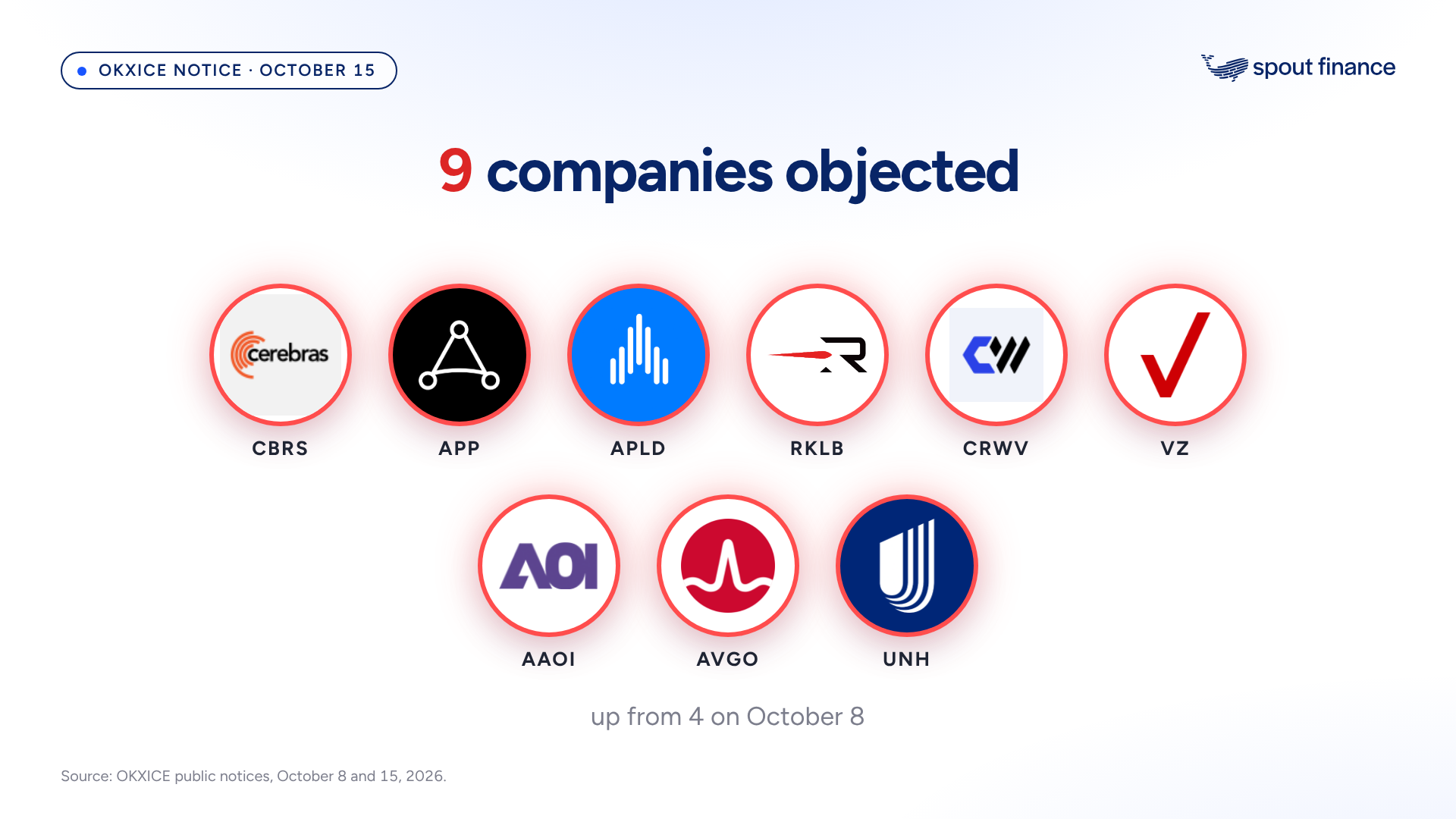
OKXICE revised its notice concerning a proposed Tokenized Securities Venue under the SEC’s temporary Innovation Exemption. Its October 15 notice named nine companies that had objected to the proposed tokenization of their securities: Cerebras, AppLovin, Applied Digital, Rocket Lab, CoreWeave, Verizon, Applied Optoelectronics, Broadcom, and UnitedHealth.
 The revised notice described a proposed venue with 24/7 trading and cited limits of 75 symbols in LULD Tier 1 and 250 in Tier 2. It did not provide a start date or a final list of eligible stocks. Based on the 30-day notice period and the initial notice on October 4, November 3 would be the earliest possible start, though no launch date has been announced.
The proposal follows earlier notices and objections, but the expanded list highlights a central question for tokenized equities: how should platforms handle securities when the underlying issuers object to their tokenization?
The issue became more visible on October 15, when AMC CEO Adam Aron said AMC would not consent to Robinhood stock tokens in the United States, describing them as synthetic, according to The Defiant. No formal objection filing was identified in the research for this week, and the legal implications of issuer consent for offshore tokenized products remain unresolved.
Perpetuals.com added another development on October 14, publishing a notice of its intent to rely on the SEC’s temporary exemption for Tokenized Securities Venues. Its announcement did not name specific stocks, a blockchain, or a start date. CoinDesk separately reported that trading would use permissioned automated market maker pools paired with USDC on the company’s Kronos X Public network, with a potential start in mid-November. Those operational details were reported by the outlet rather than established in the company’s announcement.
These notices do not amount to SEC approval of a particular venue or token. They state an intention to rely on an exemption; whether an operator satisfies the applicable conditions is a separate question.
Formation, the company created by the merger of Orca and Loopscale, has said it plans to operate a tokenized securities venue, but no notice was identified this week. According to the Orca Council’s forum post, the ORCA tokenholder vote on resourcing Orca for the restructuring opened on October 13 and closes on October 18 at 18:38 UTC. It needs at least 3 million ORCA voting yes and more yes votes than no votes to pass.
The regulatory discussion also gained a broader institutional dimension. On October 14, SEC Trading and Markets Director Jamie Selway described tokenization as “a promising technology in early days of limited deployment.” His remarks emphasized innovation alongside the need to avoid regulatory arbitrage, with “innovation without arbitrage” described as the SEC’s watchword. He also said he expects at least four exchanges to begin trading perpetual futures on securities this quarter.
For the market, tokenization is not simply a technical question about representing securities on a blockchain. It also involves issuer rights, market structure, investor protections, and the rules governing how securities can be traded.
Aave’s Stock-Backed Lending Market More Than Doubles Its Borrowing
One of the week’s clearest developments in tokenized-equity lending took place on Aave V4’s Coinbase Stocks market on Base.
On October 17, the market held approximately $14.54 million in supplied assets, up from $10.04 million the previous week, according to Aave V4 data. Tokenized-stock collateral increased from approximately $4.76 million to $9.26 million, while USDC borrowing rose from $1.55 million to $3.96 million.
The market operates under a $21 million hub-level cap. USDC utilization reached 75.1%, and the USDC borrow APY was approximately 3.39% at the time of the data read.
The increase followed the launch of USDC supply incentives on October 13. The program offers USDC rewards through Merkl to suppliers in Aave’s Coinbase Stocks market for seven tokenized equities: Apple, Amazon, Alphabet, Meta, Microsoft, Nvidia, and Tesla. It runs until the budget is exhausted, but the budget was not disclosed. US persons are excluded.
The timing is notable, but it does not establish that incentives alone caused the increase. The data shows that borrowing against tokenized stocks can grow when assets, lending infrastructure, and incentives are available together.
The market also provides a useful measure of how much activity is occurring beyond simply holding or trading tokenized equities. Coinfomania reported on October 17, citing Token Terminal, that 144 wallets were borrowing USDC against tokenized stocks on Aave V4, up from eight at launch. The report put collateral at $9 million and borrowing at $3.8 million, broadly consistent with the onchain data read. The measurement date was not given.
However, one week’s growth is not enough to establish how durable the demand will be. The incentive program’s budget and eventual end date will matter when assessing whether borrowing activity persists without additional rewards.
Venus Reaches the End of Its bStocks Reward Campaign
Venus offers a contrasting development. Its Merkl reward campaign for borrowing USDT or U against selected bStocks ended on October 14, with no replacement campaign listed as of October 17.
The campaign ran from September 16 and offered a 4,000 USDT reward pool for borrowing against SKHYB, NVDAB, TSLAB, and SPCXB. At the end of the campaign, the tracked borrowing balance was approximately $259,600, and the reward APR had fallen to zero.
Borrowers now face the applicable variable borrowing rate without that additional campaign reward.
Aave and Venus illustrate two different stages in the development of stock-backed lending. Activity has risen on Aave alongside a new incentive program, while Venus’s reward campaign has ended. What happens after incentives change will help show whether borrowing activity can persist without additional rewards.
Across the market, stock-backed lending is still small. Castle Labs estimated on October 15 that just over $65 million of tokenized equities are earning yield, mostly xStocks used as collateral on Kamino and Jupiter Lend.
DeFi Lending: TVL Edges Lower Across Major Protocols
DefiLlama’s October 17 snapshot showed modest declines across most major lending protocols over seven days, with one large move at USD.AI. The seven-day change is measured against October 10 and the 30-day change against September 17.
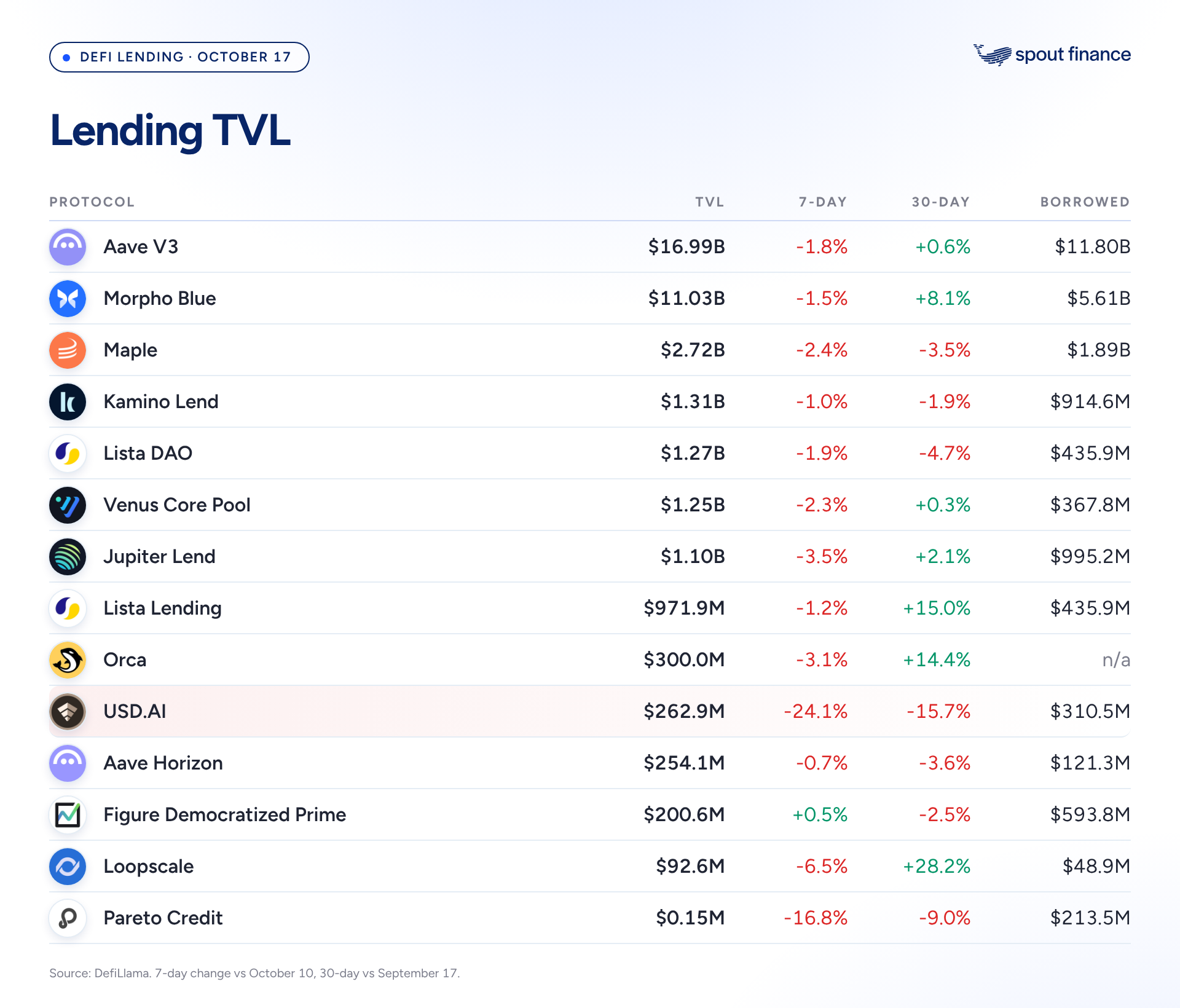 USD.AI’s decline came almost entirely from PYUSD leaving the protocol, a drop of about $83.3 million. Loopscale’s decline was mostly USD.INFRA falling to zero. Maple’s came mainly from USDC and USDT, and Jupiter Lend’s was spread across USDe, JLP, USDC and JupSOL. These observations come from DefiLlama’s token-level data, and no dated public explanation was found for any of the moves.
Lista DAO and Lista Lending report the same borrowed figure and should not be added together. For Figure and Pareto, the borrowed column is the better measure of the loan book, because their TVL reflects only unmatched supply.
Spout Raises $2 Million to Build Stock-Backed Lending on Solana
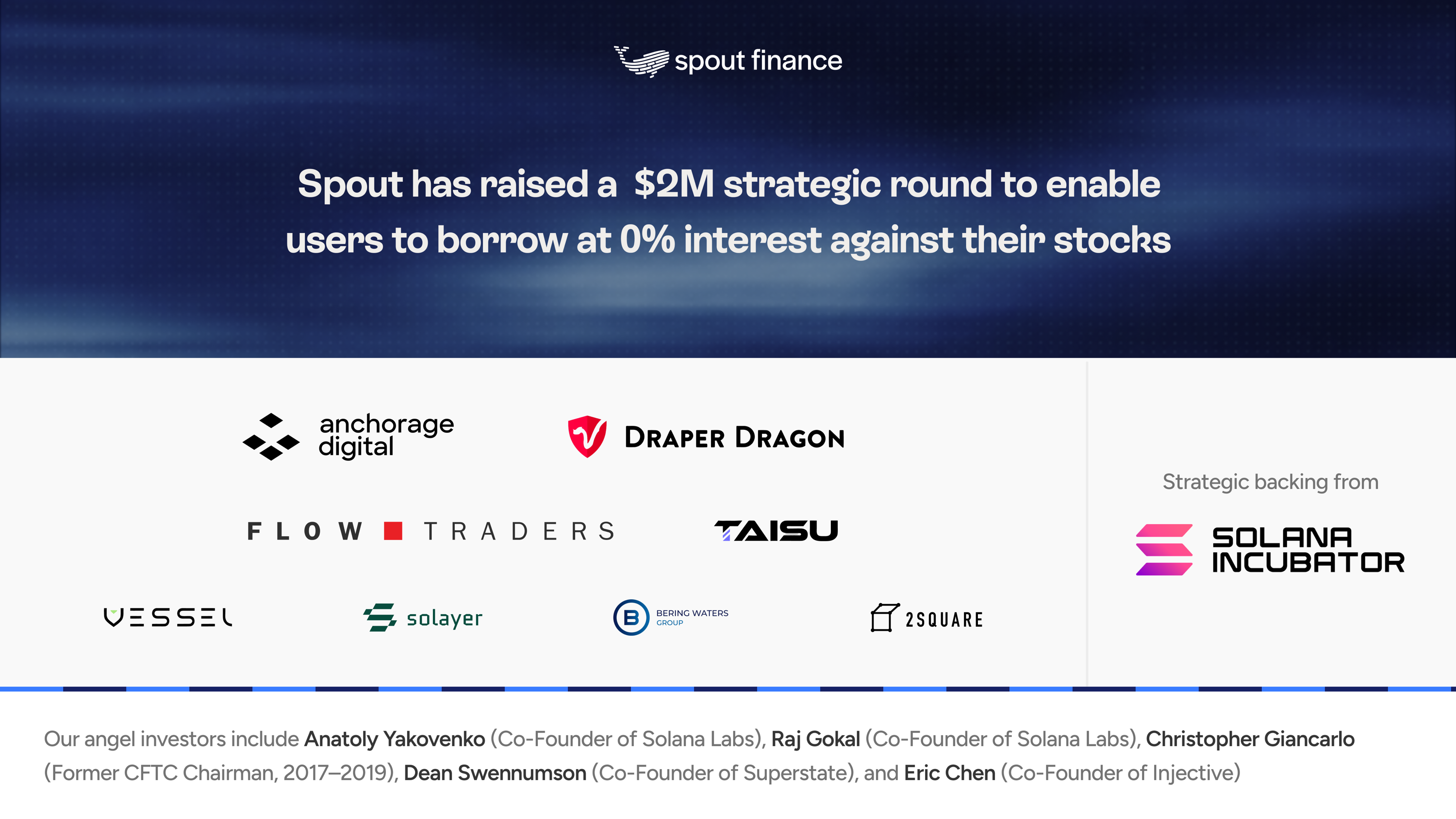
Spout announced a $2 million strategic funding round on October 15, backed by Draper Dragon, Anchorage Digital, Flow Traders, Taisu Ventures, Vessel Capital, Solayer, 2Square Capital, Bering Waters Ventures, and Blockstreet Capital, with strategic backing from Solana Labs.
The round also includes angel investors Anatoly Yakovenko and Raj Gokal, J. Christopher Giancarlo, Eric Chen, Dean Swennumson, and Anna Yuan.
 We’re building a way for individuals to borrow against eligible tokenized US equities at 0% interest, so they can access liquidity without selling their underlying exposure.
The funding will support our work on stock-backed lending and the infrastructure needed to make tokenized equities useful beyond holding and trading them.
Our model is designed to let users borrow USDC against eligible tokenized US equities at a flat 50% loan-to-value ratio, with 0% interest for borrowers. Lender yield comes from systematic covered-call premiums written against the collateral, rather than token emissions or temporary borrowing incentives.
Spout’s model is designed to serve both sides of the market: borrowers can access liquidity while maintaining their underlying stock exposure, while lenders receive yield generated through the covered-call strategy. The aim is to connect tokenized equity ownership with a practical lending use case.
We’re developing this product as tokenized stocks expand across platforms and lending protocols test how these assets can be used as collateral. Our focus is on helping connect tokenized assets to borrowing and lending through a model with a defined source of lender yield.
Other tokenization infrastructure companies also announced funding this week. On October 15, Multiliquid announced a seed round led by Polychain, with Circle Ventures participating, bringing its total funding to $8 million. Fortune reported that Fission raised a $10 million Series A led by Pantera, with Circle Ventures participating; the round had closed in September.
Traditional Finance Continues Testing Tokenized Collateral
Beyond tokenized equities, several developments this week showed financial institutions applying blockchain infrastructure to established financial instruments.
On October 13, BNY and Citadel Securities completed a tokenized Treasury transaction through a triparty repo arrangement. Citadel purchased a two-year Treasury through BNY on Tradeweb. The asset was tokenized on BNY’s private ledger, settled within minutes, and used as collateral in an overnight triparty repo.
BNY described the transaction as the first use of tokenized assets on a major triparty repo platform. No transaction size was disclosed, so the significance lies in the reported use of tokenized collateral within an established institutional workflow rather than the scale of the trade.
The development illustrates a different side of tokenization from retail-facing stock tokens. In institutional markets, the focus is often on settlement efficiency and the ability to mobilize collateral across financial transactions.
Europe also recorded a significant issuance. Luxembourg issued a €1.7 billion, 10-year sovereign bond natively on distributed ledger technology on October 14, carrying a 3.70% coupon. The bond was issued through LuxCSD on Clearstream’s D7 platform.
On October 15, Iberdrola, BBVA and Santander announced a €150 million syndicated loan administered over its full lifecycle on a blockchain platform built by ioBuilders. The announcement describes a loan managed on distributed ledger technology, not a tokenized loan.
On October 13, Federated Hermes and Prometheum announced a strategic partnership with a planned collaboration on tokenized funds. Their first product is expected in Q1 2027, although no specific fund was named.
WisdomTree’s WTGXX tokenized money market fund also received a AAA rating from Particula on October 14. WisdomTree reported fund assets of approximately $1.2 billion as of October 13.
Victory Park Capital and Tradable launched VALTS on October 15, a tokenized feeder into an asset-backed credit interval fund, issued on Stellar for US qualified purchasers.
Standard Chartered began custody of Ripple’s RLUSD stablecoin through its DIFC branch on October 12. Using RLUSD as collateral with LMAX is planned but remains subject to final documentation and testing.
Some institutional timelines moved later. Morgan Stanley’s Amy Oldenburg told The Block on October 12 that the firm’s alternative trading system support for tokenized equities has slipped to Q1 2027.
These developments show tokenization reaching beyond equities into sovereign debt, syndicated loans, money-market funds, private credit, and institutional collateral operations. Each asset class, however, requires its own legal structures and infrastructure, even when the underlying technology is similar.
Regulation Moves from Individual Products Toward Broader Market Frameworks
Regulatory developments this week extended across the United States, Europe, and Australia.
On October 12, Financial Stability Board Chair Andrew Bailey wrote to G20 finance ministers ahead of their October 15 meeting in Bangkok, attaching a note on cross-border vulnerabilities in global stablecoin arrangements.
On October 14, the European Banking Authority classified USDC as the first significant e-money token under MiCA. Dual supervision under the framework is scheduled to begin on November 12, 2026.
The European Supervisory Authorities also identified tokenization as an area of focus in their 2027 work program. Separately, the International Monetary Fund used its October Global Financial Stability Report to examine both the potential efficiencies and vulnerabilities of tokenized markets, presented at its Annual Meetings in Bangkok on October 13.
The IMF’s analysis warned that tokenization could create new channels for leverage and liquidity and maturity mismatches. Its findings, reported by CoinDesk on October 11, also estimated that tokenized shares were around 1.5 times as volatile as their underlying shares, with lower liquidity and more than half of trading taking place outside US market hours. About 80% of trades were smaller than one share. The report estimated tokenized equities at approximately $2.3 billion as of July 31, using its own dataset and methodology.
These estimates are not directly comparable with RWA.xyz’s current market value because the datasets and measurement dates differ. They nevertheless highlight an important consideration: growing issuance does not automatically mean tokenized markets have the same liquidity or trading characteristics as their underlying traditional markets.
In the United States, the SEC approved a FINRA rule change on October 15 allowing projected or targeted returns in certain communications, subject to conditions and primarily for institutional audiences. The SEC also published its proposed custody rule in the Federal Register on October 6, with comments due December 7.
The CFTC’s October 5 proposal on retail leveraged crypto transactions was published in the Federal Register on October 13, with comments due December 14. On October 15, OCC Comptroller Jonathan Gould was reported by Coin Edition to have said that final rules under the GENIUS Act would come “in the very near term.”
On October 15, Australia’s ASIC opened a consultation on digital asset and tokenized custody platform rules, with submissions due November 27 and the relevant laws scheduled to commence on April 8, 2027.
None of these developments establishes a single, settled regulatory approach to tokenized securities. Instead, they show supervisors addressing different parts of the market, from custody and disclosures to stablecoin oversight and trading infrastructure.
Solana’s Next Major Upgrade Gets a Date
Solana’s Alpenglow consensus upgrade is scheduled for mainnet-beta activation at epoch 1064, beginning October 21 at approximately 15:00 UTC, according to the upgrade page as of October 17.
The rollout plan specifies that TowerBFT will continue for the first 5,000 slots before Alpenglow takes over at slot 459,653,000. The upgrade had not yet activated at the time of the research.
Alpenglow is separate from Solana’s previously discussed slot-time improvements. Its scheduled activation is an important network development to watch, particularly as tokenized assets, lending applications, and institutional financial products continue building on Solana.
Other ecosystem developments included Bitso listing Western Union’s USDPT stablecoin in Mexico on October 13, and the listing of Pando Finance’s spot Solana ETF in Hong Kong, the city’s second, on the same day. Kamino named two US hires for institutional expansion on October 16. On October 12, the Solana Foundation also announced more speakers for Breakpoint 2026, scheduled for November 15 to 17 in London.
Solana’s ecosystem activity remains relevant to tokenized finance, but network upgrades and new listings should be assessed on their own terms rather than treated as evidence of adoption for any individual tokenized asset or lending product.
Market Conditions: Treasury Yields, Lending Rates, and ETF Flows
Macro conditions remain part of the backdrop for onchain lending and yield products.
The 13-week US Treasury bill’s coupon-equivalent yield rose from 4.16% on October 9 to 4.18% on October 16, reaching 4.20% on October 14 and 15, according to Treasury data.
At the October 17 data read, Aave V3 Ethereum USDC supply was yielding approximately 3.78% APR, around 40 basis points below the bill yield. Sky’s Savings Rate remained at 3.80%, roughly 38 basis points below. Maple’s syrupUSDC recorded a seven-day APY of 5.24%, around 106 basis points above the bill, while Ethena’s sUSDe yield was 4.75%, approximately 57 basis points above.
These comparisons are indicative rather than exact. Treasury yields, protocol APR, and APY use different calculation methods, and their spreads should be treated as approximate.
The Federal Reserve’s next FOMC meeting is scheduled for October 27 to 28. Economic releases this week included September CPI, producer prices, retail sales, and the Beige Book. September headline CPI, released by the BLS on October 14, rose 0.6% month over month and 3.7% over 12 months, while core CPI rose 0.3% month over month and 2.6% over 12 months. On October 15, the BLS reported producer prices for final demand up 1.3% on the month and 6.3% over 12 months, and the Census Bureau reported retail sales up 0.8% to $745.0 billion.
Spot Solana ETF flows were also negative throughout the week. Farside data recorded daily net outflows of $0.7 million on October 12, $1.0 million on October 13, $1.3 million on October 14, $9.8 million on October 15, and $12.7 million on October 16. The weekly total was approximately $25.5 million in outflows, including $18.8 million from BSOL. Together with the previous week, Solana spot ETFs have now recorded ten consecutive trading days of net outflows, from October 5 to 16.
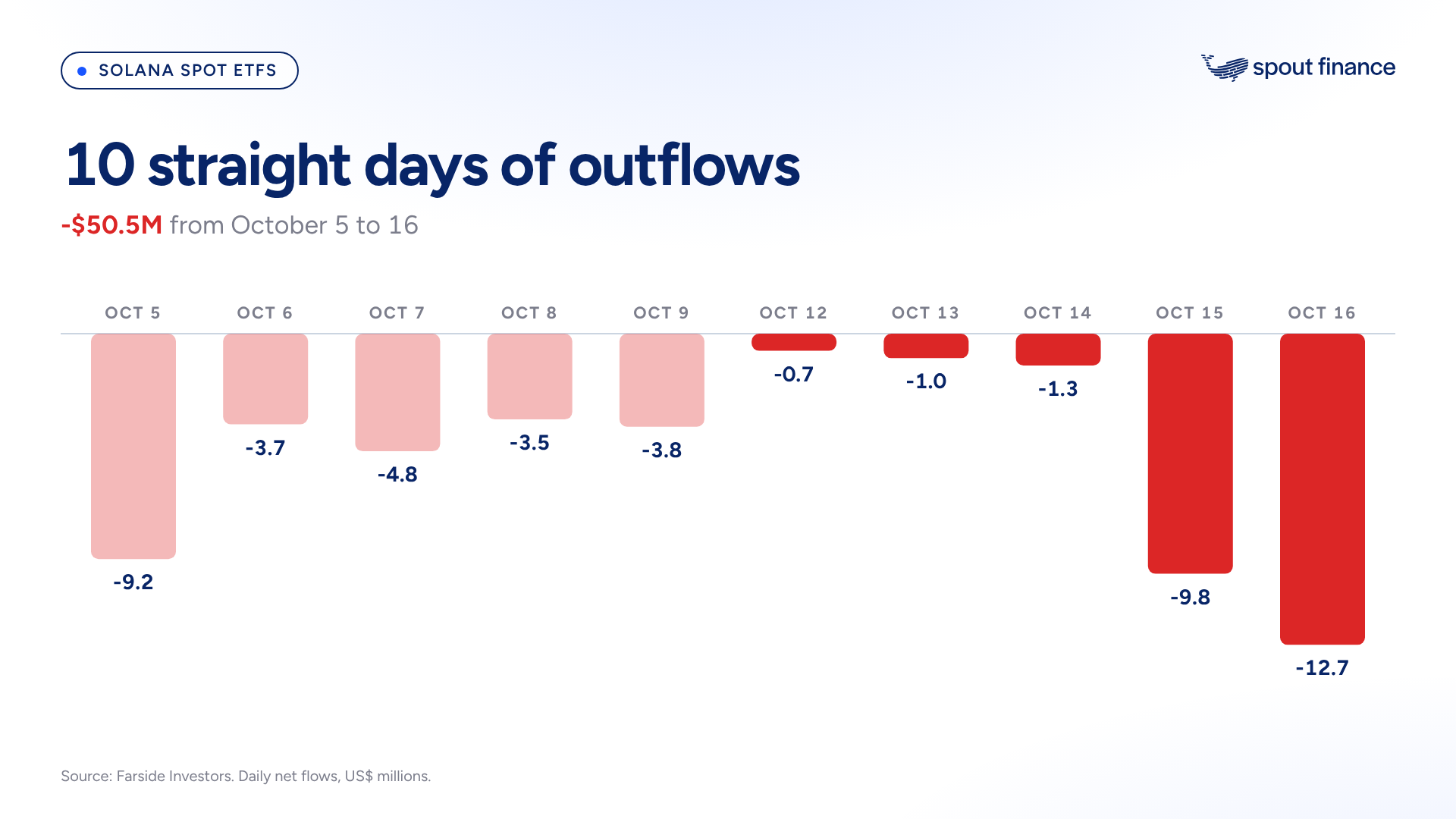 Those flows provide context for the broader Solana investment market, but they should not be confused with activity in tokenized stocks or DeFi lending. Each measures a different part of the ecosystem.
What This Means for Spout Finance and Its Users
This week’s developments reinforce the opportunity we’re building toward: making tokenized equities useful beyond holding and trading them.
The market is growing, but only a small share of tokenized equities is currently being used in lending. That gap matters because ownership alone does not give holders a straightforward way to access liquidity without selling their assets.
This is the problem we’re working to solve. We’re building Spout to let users borrow USDC against eligible tokenized US equities at a flat 50% loan-to-value ratio and 0% interest, without selling their underlying exposure. Lender yield comes from systematic covered-call premiums written against the collateral, rather than token emissions or temporary borrowing incentives.
For users, the aim is to make tokenized equities more useful while keeping the product’s borrowing and lending mechanics clear. Borrowers can access liquidity against eligible assets, while lenders have a defined source of yield. The model is built around the collateral and covered-call strategy, rather than short-term rewards.
Our strategic funding will support our work toward this vision. Spout beta is currently running on Solana Devnet, with a private beta planned as we continue developing the product.
What to Watch Next
Several upcoming dates could shape the next stage of tokenized finance and the Solana ecosystem.
- October 18: The ORCA governance vote on resourcing the Formation restructuring closes at 18:38 UTC.
- October 21: Solana’s Alpenglow upgrade is scheduled to activate at epoch 1064, around 15:00 UTC.
- Late October: Samsung Wallet’s planned USDC transfers for US users are expected in the final week of the month. The Block reported on October 12 that DTCC’s tokenization service is expected by the end of October. DTCC had not confirmed a launch as of October 17.
- October 27 to 28: The next Federal Reserve policy meeting.
- Around November 3 at the earliest: OKXICE’s proposed venue could begin operating, based on the 30-day notice period. No start date has been announced.
- November: Bybit’s target for mStocks. Perpetuals.com’s potential mid-November venue start is based on secondary reporting, not a confirmed launch date.
- November 11: The comment period on Korea’s proposed tokenized securities rules closes.
- November 12: MiCA’s dual supervision for USDC as a significant e-money token begins.
- November 15 to 17: Solana Breakpoint 2026 in London.
- November 27: Submissions due on ASIC’s digital asset and tokenized custody proposals.
- December 7 and 14: Comment deadlines for the SEC custody proposal and CFTC retail leveraged crypto transactions proposal, respectively.
For stock-backed lending, the key near-term developments are whether Aave’s Coinbase Stocks market sustains its recent activity after incentives run their course, and whether any lending protocol begins accepting Securitize’s Solana stocks as collateral. Neither had been confirmed by the end of this research window.
The Bigger Picture
This week’s developments show tokenized finance advancing on several fronts, but not at the same pace. New products are expanding access, institutions are testing tokenized collateral in established workflows, and regulators are addressing the rules around trading and custody. Issuer objections show that the market’s legal and operational questions remain unresolved.
The next phase will depend on how well these products connect to existing financial infrastructure. Legal rights, custody, settlement, and the ability to use assets as collateral will shape whether tokenization can move beyond representation and become useful across more financial activities.
For tokenized equities, the central challenge is turning wider availability into practical utility. The market’s progress will depend not just on how many assets are issued, but on whether people and institutions can use them reliably across trading, borrowing, and other financial activities.